The Daniel Boone Chorus in the 1970s

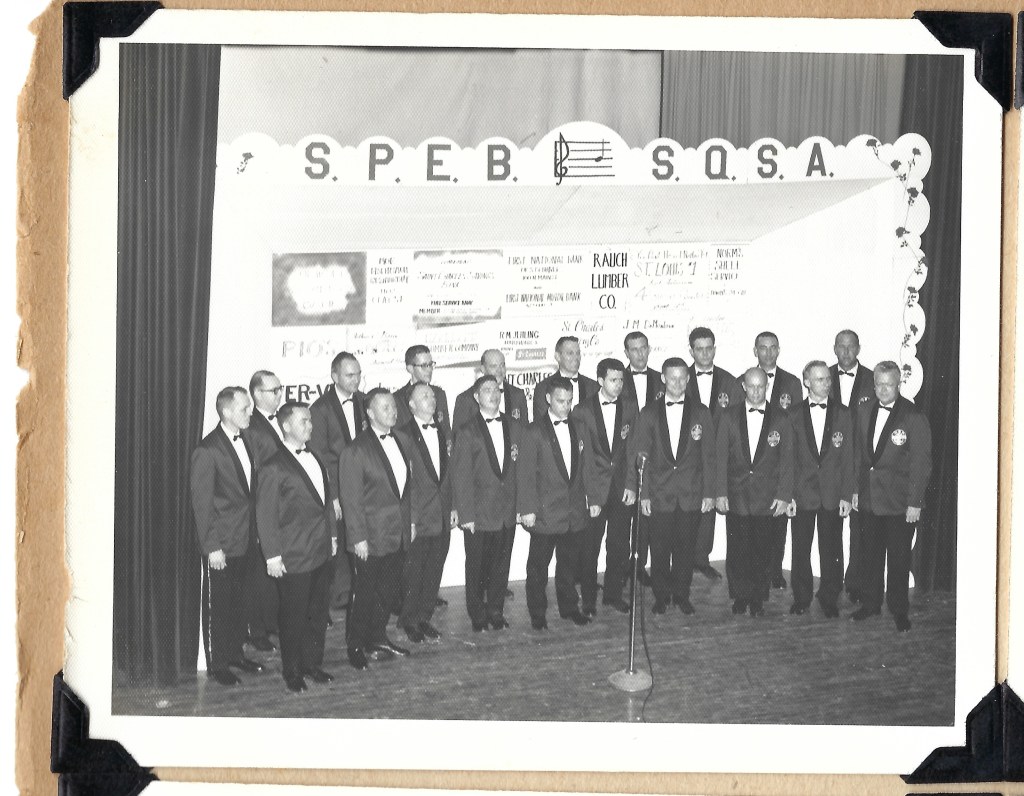
The singing in fledgling barbershop chapters is not always the best, but there is a fun camaraderie that can be formed in singing together. In 1970, the Daniel Boone Chorus marked its seventh anniversary. The chapter experienced some ups and downs in the 1970s but survived the decade in preparation for what lay ahead next.

              Jerry Coen served a second term as board president in 1970.[1]  Junior Fisher was Administrative Vice-President, Larry Groeblinghoff was Program Vice-President, Don Clark was Secretary, Bill Morton was treasurer, Larry White was Bulletin Editor, Bob Henry was in charge of Public Relations, and Roy Seigler (1927-1997) served as the chapter contact.  Coen, Fisher, Groeblinghoff, and Henry attended the Chapter Officers Training School in Lincoln, Nebraska, on 17-18 January 1970. [2]  5-11 April was Barbershop Harmony Week, again by proclamation of Mayor Henry C. Vogt (1903-1992) of St. Charles.[3]  Jerry Coen gave a gushing report to the chorus over the June show.  He singled out Dave Moorlag for promoting the location of the show as the St. Charles Cinema and Woody Ashlock, who wrote the show, was M.C., helped with scenery, painted most of it, put an act in the show, and directed the show.[4]  The show was presented on 11 June 1970.[5]  On 29 July, the chapter hosted “St. Charles Style Jamboree” at the new Knights of Columbus Hall at 3 Westbury Drive in St. Charles.[6]  The “non-fishing trip” continued as an annual Labor Day event.[7]  The chorus posted a second-place finish at the St. Louis Area Barbershop Chorus Contest in 1970.[8]  However, they finished first in the Small Chorus Competition at the Central States District in Davenport, Iowa later that year.[9]  The chorus received a trophy for being the best chorus with less than thirty men.[10]  The chorus finished tenth overall at that competition, which was held on 17 October.[11]  The chapter allowed the St. Charles Sweet Adeline Chapter to borrow sets and props for their show.[12]  The chorus participated in the 22nd Annual Parade of Harmony, presented by St. Louis No. 1 Chapter, Saturday, 7 November 1970 at 8 p.m. at the Kiel Opera House in St. Louis.[13]  The St. Charles Chapter held a coon hunt on 13 November 1970 in St. Paul, Missouri.[14]  The Daniel Boone Chorus won the Christmas Caroling Contest, held from Thanksgiving to Christmas.  Four singing groups entered the contest, “singing on separate evenings.”  Capt. George Overly of the Salvation Army presented a plaque to Board President Jerry Coen.[15]

              In January 1971, new chapter officers were selected by the chapter members.  The new officers were installed at the Mother-in-Law House in St. Charles.[16]  William Earl “Bill” Morton (1930-1991) was president, Donald Ray “Don” Spiegel (1929-2003) was vice-president of administration, Ralph Joseph Fisher (1927-1988) was vice-president of programming, Col. Kenneth Arthur “Ken” Schroer (1939-2015) was secretary, Bert Volker was treasurer, Gerald Mohr was bulletin editor, Robert Elwin “Bob” Henry (1936-1980) was District Area Counselor, and Howard Vane “H. V.” Jacobs (1935-2003) was in charge of the chapter’s public relations.[17]  A picture of the chapter leadership was taken in front of the Nebraska Center for Continuing Education in Lincoln, Nebraska, where they attended to COTS.[18]  Some pictures of a 1971 board meeting are in the Daniel Boone Chorus, 1970-1971, binder in the chorus’ archives.  Newcomer Robert “Bob” Hall oversaw uniforms.[19]  Bill Morton, prior to becoming Chapter President, was Chapter Secretary and Treasurer in 1969 and 1970.  He developed a bookkeeping and record maintenance system for the chapter board.  He was the first chapter president to bring the chapter in debt.  The debt was accrued from the purchase of a professional sound system.  Morton used his basement to store chapter equipment.  He was Co-Chairman of Registration for the 1969 International Barbershop Convention in St. Louis and served as Treasurer of the St. Louis Area Barbershop Council in 1972 and 1973.  He was known for having an analytical mind and keen eye for organization.  He worked as a production planner for McDonnell Douglas.[20]  The chorus performed at the O’Fallon Sweet Adelines Guest Night on Monday, 13 February 1971 at 7:30 p.m. at St. Dominic High School in O’Fallon.[21]  The Daniel Boone Chorus launched Operation HARMONY (Hope And Rehabilitation Means One of us Needs You) in 1971 to help a thirty-four-year-old man who had recently had surgery to remove a brain tumor.  The family could not afford bills, so the chorus decided they would raise money to help.[22]  The 1st Annual Barbershop Show-Dance presented by the St. Charles Barbershop Choirs and Quartets was at the Community Club Building in Wentzville, MO, at 8 p.m. on Saturday, 20 March.[23]  It was for the Optimists Club of Wentzville.[24]  The chorus was hosted by the Mark Twain Merchants Association.  “The best little chapter in the Central States District” performed at the Mark Twain Shopping Center during Barbershop Harmony Week (11-17 April) in 1971.[25]  In May, the chorus performed for Our Lady of the Presentation Church of St. John, Missouri.[26]  Mutual Funs, a quartet consisting of members of the St. Charles Chapter (Bob Henry and Bert Volker), and members of the St. Louis Chapter (John Jewell and Ron Grooters) performed in “The Music Man” at the St. Louis Muny from 26 July to 1 August 1971.[27]

The chorus sponsored a float in the Missouri Sesquicentennial Parade of 1971.  This is the only photo of the Daniel Boone Chorus in the possession of the St. Charles County Historical Society.[28]  The St. Louis Area Barbershop Contest was held at Webster Junior High School in Collinsville, Illinois, on 11 September 1971.[29]  The Daniel Boone Chorus finished thirteenth in the Central States District Chorus Competition at Wichita, Kansas, on 2 October.[30]  Gordon Manion turned over the reins of directorship to Carl Daniel in October 1971.[31]  The chorus announced a new director in December 1971.  Donald Joe “Don” Nevins (1942-2003) taught music at Central Junior High School in the Riverview Gardens School District and previously had directed the Alton (IL) Barbershop Chorus, the St. Louis Archway Chorus, and the Overland Sweet Adelines Chorus.  His quartet experience included the Boot N Aires of Bloomington, Illinois, and the Hartsmen of Illinois.  He won the St. Louis District Metropolitan Opera Auditions in 1969 and 1971, performed with the Mississippi Valley Opera Company, and sang at the First Church of Christian Science of St. Louis and the Temple Shaare Emeth in St. Louis.  At the time, Nevins became director of the Daniel Boone Chorus, the St. Charles Chapter boasted fifty members and was rehearsing on Wednesday nights at St. John’s United Church of Christ’s Church Hall at Fifth and Jackson streets in St. Charles.[32]

              From 1972 to 1973, Ken Schroer was St. Charles Chapter Board President.  Kenneth Arthur Schroer was born on 2 December 1939 in St. Louis to Arthur John and Mabel (McGahan) Schroer.  He was a colonel in the United States Air Force.[33]  He formed a bylaws committee to establish a firm set of guidelines for future chapter boards.  He served as board secretary, on the public relations committee, was a St. Louis Area Councilor in 1974, and was the Central States District Chairman for International Hospitality in 1974 and 1975.  He served on the CSD Long Range Planning Committee and was CSD President in 1978.[34]  On 19 February 1972, the St. Charles Chapter of S.P.E.B.S.Q.S.A. hosted “An Evening of Barbershop” at the Kiel Opera House at 8 p.m.  The show featured the six-time Central States District Champion, the Pony Expressmen Chorus of St. Joseph, Missouri; the four-time St. Louis Area Champion, the St. Louis Suburban Chorus; Central States District Small Chorus Champion, the Daniel Boone Chorus; 1971 Central States District Quartet Champion, the Mid-Continentals; 1971 Central States District medalists, the Men of a Chord; and the Key Pickers.[35]  On 1 March 1972, the chorus held a guest night.[36]  The chorus performed far and wide in the community, including bi-monthly at the Emmaus Home in St. Charles.  At Christmastime, the chorus would go caroling.[37]  In June 1972, chorus members pitched in to paint the newly opened St. Charles Youth Center.[38]  The Daniel Boone Chorus was involved in the Festival of the Little Hills beginning in August 1972.[39]  This eventually became an annual affair in which they gave back to the local community by serving up music, food, and beer at the Festival of the Little Hills.[40]  The chorus co-sponsored, with the St. Charles County Sheriff’s Rescue Squad, a beer garden along the riverfront on property recently purchased by the City of St. Charles for a riverfront park.[41]  The chorus maintained its presence at the festival until 2002. The following month, the chorus performed at the Civic Park Pavilion.[42]  During the weekend of 6-8 October 1972, the chorus (now boasting 54 members) finished in tenth place at the Central States District Chorus Contest in Des Moines, Iowa.[43]  On 11 November 1972, the Daniel Boone Chorus performed for the Joseph L. Mudd Parent-Teacher Club at the J. L. Mudd School in O’Fallon, Missouri.[44]  On 29 November 1972, the chorus hosted the Fifth Wednesday Jamboree at the Knights of Columbus Hall in St. Charles.  Participants included S.P.E.B.S.Q.S.A St. Louis Suburban, Florissant Valley, Kirkwood, St. Louis No. 1, and Collinsville (IL) chapters.  Among the quartets who performed were Men of a Chord, Gaslight Squires, the Gadabouts, and the Pea Pickers.[45]  The Daniel Boone Chorus finished in tenth place in the Central States District Chorus Competition in 1972.[46]  The chorus had the Daniel Boone Chorus Auxiliary, a group of wives who supported their husbands in singing barbershop.  The auxiliary was renamed the Becky Boone Tagalongs in 1973.[47]  The chapter currently does not have an auxiliary for the spouses of chorus members, but the Ambassadors Circle could be considered a successor to such auxiliaries.

              1973 brought more milestones for the chorus.  The Daniel Boone Chorus held a Guest Night in March.[48]  The chorus raised $672 for the St. Charles County Sheriff’s Reserve at the Festival of the Little Hills in 1973.  By that time, Ken Schroer was president and Dave Smith was secretary.  Daniel Boone Chorus member Jerry Coen served on the festival committee.[49]  The chorus finished eleventh in the Central States District Chorus Competition in 1973.[50]

              Shiz Hori was president in 1974.  Hori joined the chapter in 1972.  At the time, he was a resident of Hazelwood, Missouri, and worked for McDonnell Douglas.[51]  The Daniel Boone Chorus traveled to Sioux Falls, South Dakota, the first week of May in 1974 to compete in the Central States District Preliminary Chorus Competition.  The chorus finished in second place (981 points), only six points behind the winning chorus, the Shrine of Democracy Chorus from Rapid City-Mount Rushmore, South Dakota (987 points).  The annual Spring Show was presented at St. Charles High School on 17 and 18 May at 8 p.m. with a dance to follow the Saturday night (17 May) performance at Blanchette Park.  The shows had a circus theme and a river theme based on Mark Twain.  The chorus planned to host the annual Afterglow on the final night of the International Barbershop Convention in Kansas City.  The Afterglow was in the grand ballroom of the Muehlebach Hotel.[52]

The chorus performed at the Children’s Theatre in the St. Louis Art Museum on 15 June 1974.[53]  The Daniel Boone Chorus performed in August 1974 at the Festival of the Little Hills.[54]  Don Nevins left the chorus and the country in October 1974 and was succeeded as director by Joe Richardson.[55]  Richardson was the only director to use a baton in his direction.[56]  The resignation of Nevins as director sent the chapter into turmoil.  Many of the old members left shortly after Nevins did, but many new members joined under the new director.[57]  Richard L. “Rich” Knight, a high school teacher in the Fort Zumwalt School District, joined the Daniel Boone Chorus in 1974.  Knight had previously sung with the Cosmopolitan Singers and appeared on the stage of the St. Louis Municipal Opera (the Muny).[58]  Knight later gained international notoriety in the barbershop music world as the lead of the Gas House Gang quartet.

              Ron Grooters was Chapter President in 1975.  Ron and his wife Betty were married on 30 September 1961 in Yellowstone County, Montana.[59]  He and his wife moved to St. Louis from Billings, Montana.[60]  He sang bass with the Mutual Funs in 1971 at the St. Louis Muny’s production of “The Music Man.”  Other quartet members were Bob Henry, Bert Volker, and John Jewell.[61]  The following year, Jewell was replaced by Gordon Manion and the quartet was renamed the Gaslight Squires.[62]   Grooters joined S.P.E.B.S.Q.S.A. in 1969 as a member of the St. Louis #1 Chapter.  While a member of that chapter, he was their Assistant Secretary and Sergeant at Arms.[63]  He was one of two contacts for men interested in auditioning for the St. Louis #1 Chapter in 1971.[64]  Grooters joined the St. Charles chapter in 1972 and sang with the Daniel Boone Chorus and, later, the Ambassadors of Harmony until 2020.  He taught Industrial Arts at Oakville Junior High School and lived in Mehlville, Missouri.[65]  Grooters was later involved in two other quartets, Rivertown Sound and E-Male (1999-2000).[66]  He was director of community education and extended services when he became assistant principal of Mehlville High School.[67]  Jim Henry wrote a letter petitioning the chapter to join as an eleven-year-old in 1975.[68]  The result was a change in the chapter rules allowing members under the age of sixteen if their father was already a chapter member.[69]  At the time Jim joined the chorus, attendance averaged about twenty-five men who rehearsed sitting down.  His father, Robert “Bob” Henry was already a member of the chorus and a member of the Gaslight Squires barbershop quartet.[70]  Auditions in 1975 were held at Old Tyme Barbershop at 501 S. Fifth St. in St. Charles.[71]  On 1 March 1975, the chorus performed a mini-show along with barbershop quartets and a dinner dance at St. Charles Borromeo Catholic Church at Fifth and Decatur streets.[72]  On 13 September 1975, the chorus hosted the ninth annual St. Louis Area Barbershop Chorus and Quartet Contest at Ladue High School.  The chorus finished fourth in the chorus competition and a quartet, the Gaslight Squires, from the chorus finished third in the quartet contest.[73]  Other performances included singing in churches on Sunday mornings and an 27 August “sing-out” at Emmaus Home on Randolph Street.[74]  The chorus added five new members in early October 1975:  Marvin Boles (1924-1999), Knowles Dougherty (1934-2016), Harlan Ebeling (1923-2017), the aforementioned James Henry, and Bob Porchey (1937-2014).[75]  Jim Henry served in several roles until becoming director of the Daniel Boone Chorus in 1990.  He continued in that role until 2013, when he became co-director.  The chorus performed, alternating with the Ladue High School Chorus, on 10 December 1975 at Plaza Frontenac.  Both choruses shared the same director, Joe Richardson.[76]  The Daniel Boone Chorus finished in ninth place in the Central States District Chorus Contest.[77]

              In January 1976, the Daniel Boone Chorus performed at the 59th annual installation banquet of the St. Charles Chamber of Commerce at Stegton Ballroom.[78]  Joe Richardson left the position of chorus director.  Bob Henry and Gordon Manion co-directed the Daniel Boone Chorus from January to October 1976.[79]  Bert Volker also helped in directing the chorus.

Larry Bloebaum was Chapter President in 1976.[80]  A native of Mokane, Missouri, Bloebaum moved to Florissant and was employed by McDonnell Douglas.[81]  He joined the St. Charles Chapter in the spring of 1973.  He was elected Board Treasurer in 1974.  The chapter board decided to have the chorus present “Bicentennial Revue.”  The show produced positive results and new members joined the chorus.[82]  Bloebaum later moved to Jefferson City, Missouri, but continues as an off-risers member of the St. Charles Chapter.[83]  Twelve men auditioned for the chorus on 26 May 1976.[84]  On 20 June 1976, the chorus performed at Six Flags over Mid-America.[85]  In August 1976, the chorus took over the First State Capitol parking lot during the Festival of the Little Hills and scheduled a variety of entertainment, including the locally renowned Patt Holt Singers.[86]  From October 1976 to October 1979, Bob Henry was sole director of the Daniel Boone Chorus.[87]  During that time, he also directed the O’Fallon (MO) Chapter of the Sweet Adelines.[88]  On 10 November 1976, the Daniel Boone Chorus held a guest night.[89]

              The chapter president in 1977 was Dick Chambers.  He joined the S.P.E.B.S.Q.S.A. and the St. Charles chapter in 1973.  Chambers was chapter secretary in 1974.  He donated video equipment to the chorus and sang in the Sound Effects Quartet.  His work transferred him to Wichita, Kansas and there became active in the Wichita Capital Chorus.  He returned to St. Louis in 1976 and then rejoined the chapter.  At the time he was employed by McDonnell Douglas and living in Florissant, Missouri.[90]  In 1977, the chorus changed rehearsal venues from St. John’s United Church of Christ to the St. Charles Presbyterian Church Hall.[91]  The chorus also changed meeting nights from Wednesdays to Tuesdays.[92]  In February, the chapter published an advertisement promoting “The recruitment of bathtub baritones, traffic jam tenors, barroom basses, and lonesome leads for the perpetuation of the barbershop sound.”[93]  On 10 September 1977, the Daniel Boone Chorus finished second in the St. Louis Area Barbershop Competition at Ladue High School in Ladue, Missouri.[94]

  Gary Goldman was Board President in 1978.[95]  Gary Steven Goldman was born 3 June 1952 and died on 18 November 2017 in Phoenix, Arizona.[96]  In 1978, the chorus performed at the Blues-Canadiens NHL game in St. Louis.[97] From 1979 to 1980, Lynn E. Bultman served as board president.[98]  Bultman is a native of Indiana.  He married on 15 October 1966 in Sunman, Indiana, to Janice Lee Klusman.[99]  He was serving with the Seabees in the United States Navy in 1968.[100]  In 1973, He became the manager of Indiana Cities Water Corporation in Newburgh, Indiana.[101]  Lynn and his wife Janice were living in St. Joseph, Missouri, in 1975.[102]  A veteran of the United States Navy, Bultman moved to St. Charles in 1976.  He joined the St. Charles Chapter of S.P.E.B.S.Q.S.A. in 1977.[103]  He was invited to the chorus by Gary Goldman.  Bultman had a background in administration and helped in structuring policies and financial programs for the chapter.  He laid the groundwork for financial stability so that the chapter could meet the needs of a growing organization while keeping in place reserves for future requirements.[104]  Bultman was vice-president and general manager of Missouri Cities, a local water company, in 1986.[105]  On 28 April 1979, the Daniel Boone Chorus finished second in the Central States District Chorus Prelims in St. Joseph, Missouri.[106]  The chorus performed at the Festival of the Little Hills on 17 and 18 August 1979.[107]  In the Fall Central States District Chorus Competition in Omaha, Nebraska, on 6 October 1979, the Daniel Boone Chorus finished eleventh out of sixteen competitors.[108]  Shortly after that district, Bob Henry stepped down from directing and was succeeded by Gene Johnson, who directed the chorus until April 1981.[109]  Under Johnson’s leadership, the Daniel Boone Chorus began participating in Christmas caroling on Main Street in St. Charles in December 1979.[110]


[1] Index card, Ambassadors of Harmony archives

[2] The Coonskin Cappers Weekly VII, no. 1 (January 1970), Daniel Boone Chorus binder, 1970-71, Ambassadors of Harmony archives

[3] Proclamation signed by Henry C. Vogt on S.P.E.B.S.Q.S.A. letterhead, 1 April 1970, Daniel Boone Chorus binder, 1970-71, Ambassadors of Harmony archives; St. Charles Daily Banner-News, April 1970, newspaper clipping in Daniel Boone Chorus binder, 1970-71, Ambassadors of Harmony archives

[4] Jerry Coen to Members of our St. Charles Chapter of S.P.E.B.S.Q.S.A., June 1970, followed by pictures of the show; St. Charles Cinema was located on Second Street until it was torn down in 1974 (see St. Charles Journal, 18 March 1974, Newspaper Archive, accessed 28 July 2020).

[5] Pictures dated 11 June 1970, Daniel Boone Chorus binder, 1970-71, Ambassadors of Harmony archives

[6] Poster advertising event, Daniel Boone Chorus binder, 1970-71, Ambassadors of Harmony archives

[7] Pictures in Daniel Boone Chorus binder, 1970-71, Ambassadors of Harmony archives

[8] St. Charles Journal, 8 October 1970, Newspaper Archive

[9] St. Charles Journal, 28 February 1972, Newspaper Archive

[10] “Chorus Wins Best Trophy,” St. Charles Daily Banner-News, 28 January 1971, Daniel Boone Chorus binder, 1970-71, Ambassadors of Harmony archives

[11] CSD Chorus Contest Official Scoring Summary, Davenport, Iowa, 17 October 1970, Daniel Boone Chorus binder, 1970-71, Ambassadors of Harmony archives

[12] Letter from Shirley White to S.P.E.B.S.Q.S.A., 5 October 1970, Daniel Boone Chorus binder, 1970-71, Ambassadors of Harmony archives

[13] Program, Daniel Boone Chorus binder, 1970-71, Ambassadors of Harmony archives

[14] Map, Daniel Boone Chorus binder, 1970-71, Ambassadors of Harmony archives

[15] St. Charles Daily Banner-News, December 1970, Daniel Boone Chorus binder, 1970-71, Ambassadors of Harmony archives

[16] This is the nickname given it by local historian Edna McElhiney Olson, but the story does not appear to be correct.  The building at 500 S. Main St. appears to have originally been a warehouse for Francis X. Kremer’s mill (as seen on the 1869 Bird’s Eye View of St. Charles).  The building sustained damage in the 1876 tornado and appears to have been redone in its current configuration shortly after that tornado.

[17] St. Charles Journal, 21 January 1971, Newspaper Archive

[18] St. Charles Daily Banner-News, 21 January 1971, Daniel Boone Chorus binder, 1970-71, Ambassadors of Harmony archives

[19] A chain of command for 1971 is in Daniel Boone Chorus binder, 1970-71, Ambassadors of Harmony archives

[20] Index card, Ambassadors of Harmony archives

[21] Newspaper clipping, Daniel Boone Chorus binder, 1970-71, Ambassadors of Harmony archives

[22] St. Charles Journal, 18 February 1971, Newspaper Archive; Karen Tuttle, “Wife sees good in husband’s surgery,” St. Charles Daily Banner-News, 22 February 1971, Daniel Boone Chorus binder, 1970-71, Ambassadors of Harmony archives

[23] Information card and program, Daniel Boone Chorus binder, 1970-71, Ambassadors of Harmony archives

[24] “St. Charles Moving Ahead,” Gerry Mohr, 3 August 1971, report in Daniel Boone Chorus binder, 1970-71, Ambassadors of Harmony archives

[25] St. Charles Journal, 15 April 1971, Newspaper Archive; St. Louis Globe-Democrat, 6 April 1971, Daniel Boone Chorus binder, 1970-71, Ambassadors of Harmony archives; pictures of this performance are also in the binder; Another article advertising this is in the Daniel Boone Chorus binder, 1971-79

[26] Mohr in Daniel Boone Chorus binder, 1970-71, Ambassadors of Harmony archives

[27] St. Charles Daily Banner-News, 23 July 1971, Daniel Boone Chorus binder, 1970-71, Ambassadors of Harmony archives; the program, a review by Frank Hunter of the St. Louis Globe-Democrat, a congrats to the quartet by Bob Goddard in the St. Louis Globe-Democrat, Wednesday, 21 July 1971; Myles Standish, “’Music Man’ Opens at Municipal Opera,” St. Louis Post-Dispatch, 27 July 1971, Daniel Boone Chorus binder, 1971-79, Ambassadors of Harmony archives

[28] St. Charles County Historical Society Photo 12.1.087, image accessed 6 July 2020

[29] Program, Daniel Boone Chorus binder, 1970-71, Ambassadors of Harmony archives

[30] Official Scoring Summary, 2 October 1971, Daniel Boone Chorus binder, 1970-71, Ambassadors of Harmony archives

[31] Note card listing directors and rehearsal venues, Ambassadors of Harmony archive

[32] St. Charles Journal, 2 December 1971, Newspaper Archive

[33] https://www.findagrave.com/memorial/153532801, accessed 20 July 2020; birthplace surmised from family’s residence in St. Louis in the 1940 U.S. Census

[34] Index card, Ambassadors of Harmony archives

[35] St. Charles Journal, 14 February 1972, Newspaper Archive

[36] “Barbershop Singers Schedule Auditions for New talent,” St. Charles Journal, 28 February 1972, Daniel Boone Chorus binder, 1971-79, Ambassadors of Harmony archives

[37] St. Charles Journal, 28 February 1972, Newspaper Archive

[38] St. Charles Journal, 12 June 1972, Newspaper Archive

[39] St. Charles Journal, 24 August 1972, Newspaper Archive

[40] Esther Talbot Fenning, “Festival of the Little Hills – Cooks Again on Riverfront,” St. Charles Post, 10 August 1995

[41] St. Louis Post-Dispatch, 23 August 1972, Newspapers.com; http://www.preservationjournal.org/public/FrontierPark/Frontier.html, accessed 7 July 2020

[42] St. Charles Journal, 25 September 1972, Newspaper Archive

[43] Gerry Mohr, “St. Charles Enjoys,” December 1972, Daniel Boone Chorus binder, 1971-79, Ambassadors of Harmony archives

[44] St. Charles Journal, 9 November 1972, Newspaper Archive

[45] St. Charles Journal, 7 December 1972, Newspaper Archive

[46] http://www.barbershopwiki.com/wiki/Ambassadors_of_Harmony, accessed 6 July 2020; St. Charles Journal, 19 October 1972, Newspaper Archive

[47] St. Charles Journal, 5 March 1973, Newspaper Archive

[48] St. Charles Journal, 26 February 1973, Newspaper Archive

[49] St. Charles Journal, 18 October 1973, Newspaper Archive

[50] https://www.barbershopwiki.com/wiki/Ambassadors_of_Harmony, accessed 7 July 2020

[51] Index card, Ambassadors of Harmony archives

[52] St. Charles Journal, 9 May 1974, Newspaper Archive

[53] St. Louis Post-Dispatch, 14 June 1974, Newspapers.com

[54] St. Charles Journal, 21 August 1974, Newspaper Archive

[55] Index card, Ambassadors of Harmony archive

[56] Index card, Ambassadors of Harmony archive

[57] Index card, Ambassadors of Harmony archive

[58] Newspaper clipping, Daniel Boone Chorus binder, 1970-71, Ambassadors of Harmony archives

[59] Montana Marriage Records, 1943-1988, www.ancestry.com, accessed 20 July 2020

[60] He and his wife are listed as parents in Montana Birth Records, 1897-1988, www.ancestry.com, accessed 20 July 2020

[61] “In Muny’s Music Man,” St. Charles Journal, 26 July 1971, Newspaper Archive, accessed 20 July 2020

[62] “Award-Winning Squires,” St. Charles Journal, 19 October 1972, Newspaper Archive, accessed 20 July 2020

[63] Index card, Ambassadors of Harmony archive

[64] Want ad placed by St. Louis No. 1 Chapter of the Society for the Preservation and Encouragement of Barber Shop Quartet Singing in America, Inc. in the St. Louis Post-Dispatch, 14 November 1971, Newspapers.com, accessed 20 July 2020

[65] Index card, Ambassadors of Harmony archives

[66] Members.barbershop.org, accessed 20 July 2020

[67] “Changes,” St. Louis Post-Dispatch, Newspapers.com, accessed 20 July 2020

[68] Joel Currier and Michael Kunz, “The Biggest Man in Barbershop,” The Harmonizer (May/June 2010), 18

[69] Index card, Ambassadors of Harmony archive

[70] http://harmonyuniversity.blogspot.com/2007/08/gold-medal-moments-by-dr.html, accessed 7 July 2020; St. Charles Journal, 31 July 1975, Newspaper Archive

[71] St. Charles Journal, 12 March 1975, Newspaper Archive

[72] St. Charles Journal, 28 February 1975, Newspaper Archive

[73] St. Charles Journal, 1 October 1975, Newspaper Archive

[74] St. Charles Journal, 24 September 1975, Newspaper Archive

[75] St. Charles Journal, 8 October 1975, Newspaper Archive

[76] St. Louis Post-Dispatch, 9 December 1975, Newspapers.com, accessed 16 December 2019

[77] http://www.barbershopwiki.com/wiki/Ambassadors_of_Harmony, accessed 7 July 2020

[78] St. Charles Journal, 19 January 1976, Newspaper Archive

[79] Index card, Ambassadors of Harmony archive

[80] Index card, Ambassadors of Harmony archive

[81] 1940 U.S. Census, www.ancestry.com, accessed 20 July 2020

[82] Index card, Ambassadors of Harmony archive

[83] Members.barbershop.org, accessed 20 July 2020

[84] St. Charles Journal, 16 June 1976, Newspaper Archive

[85] St. Charles Journal, 28 June 1976, Newspaper Archive

[86] St. Charles Journal, 19 August 1976, Newspaper Archive

[87] Index card, Ambassadors of Harmony archive

[88] Troy Free Press and Silex Index (MO), 10 May 1978, Newspaper Archive

[89] St. Charles Journal, 10 November 1976, Newspaper Archive

[90] Index card, Ambassadors of Harmony archive

[91] Index card, Ambassadors of Harmony archive

[92] St. Charles Journal, 24 February 1977, Newspaper Archive

[93] St. Charles Journal, 23 February 1977, Newspaper Archive

[94] St. Charles Journal, 15 September 1977, Newspaper Archive

[95] Index card, Ambassadors of Harmony archive

[96] Obituary, St. Louis Jewish Light, 29 November 2017, Newspapers.com, accessed 20 July 2020

[97] St. Louis Post-Dispatch, 8 February 1988, Newspapers.com, accessed 22 November 2018

[98] Index card, Ambassadors of Harmony archive

[99] Indiana Marriage Certificates, 1960-2005, www.ancestry.com, accessed 20 July 2020

[100] Greensburg (IN) Daily News, 18 April 1968, Newspaper Archive, accessed 20 July 2020

[101] Newburgh (IN) Register, 6 September 1973, Newspapers.com, accessed 20 July 2020

[102] Greensburg (IN) Daily News, 11 December 1975, Newspaper Archive, accessed 20 July 2020

[103] “Barbershop Group Adds New Member,” St. Charles Journal, 7 April 1977, Newspaper Archive, accessed 20 July 2020

[104] Index card, Ambassadors of Harmony archive

[105] St. Louis Post-Dispatch, 11 March 1986, Newspapers.com, accessed 21 July 2020

[106] 1979 Central States District scores, which were available online in 2017, but not in 2020

[107] St. Charles Journal, 16 August 1979, on microfilm at Kathryn Linnemann Branch, St. Charles City-County Library District

[108] 1979 Central States District scores, which were available online in 2017, but not in 2020

[109] Index card, Ambassadors of Harmony archives

[110] “Christmas on St. Charles’ Main Street,” St. Louis Post-Dispatch, 30 November 1981, Newspapers.com, originally clipped by David Revelle, 17 September 2016
Mariamne and Mary

It was a research project that suddenly hit a snag. Those doing the research decided to quit. The project fell to the rest of the committee. The St. Peters Historical Focus Group was tasked with providing new research on Main Street in St. Peters, Missouri. I decided to start running some of the chains of title on the properties that had already been chosen. Every history of St. Peters says the same thing about the beginning of the town, that the town of St. Peters was platted by Henry Deppe and Henry Reineke in 1868. The 1885 History of St. Charles, Montgomery, and Warren Counties claims this as do all the histories of St. Peters written since then. Every history of St. Peters is wrong. The original town of St. Peters was laid out by Hypolite Bernard before 1850 (St. Charles County, MO, Deed Book 559, p. 991, 30 July 1970). The first addition to the town of St. Peters was made in 1860 by John Baptiste Bernard and Hypolite Bernard (St. Charles County, MO, Deed Book O-2, p. 160). All the histories of St. Peters are wrong. It is possible for one to think they have figured out the truth and yet be wrong.

Ancient history is much harder to prove than the above example. Claims can be made that cannot easily be proven true or false. The name Mariamne is common among the Herodians. Mary is a common name in the New Testament. I get the sense from reading Cleta Flynn’s blog (https://mysearchforpoliticalmary.com/2015/06/06/bad-mary-part-ii/#_edn2) that she thinks Mary is one of the Mariamnes descended from Herod the Great. Considering the fact that both names were common in Roman times in the area in and surrounding today’s country of Israel, such a connection seems ridiculous to me. I mean, how do you know that Mary Magdalene or one of the other Marys mentioned in the New Testament wasn’t part of the Herodian dynasty? Such a connection is impossible to prove because of how common the name was at that time. Consider also that no evidence is given to show that the Herodians ever lived in Nazareth, which is the town Mary was living in according to Luke 1:26. Such a view would disqualify Jesus Christ as Messiah as He would not be biologically descended from David. It denies the virgin birth of Jesus Christ and claims that Matthew simply made up the details in his gospel, details for which Matthew later died. It also denies the statement made by the angel Gabriel to Mary in Luke 1:32, “And the Lord God will give to him the throne of his father David” (ESV). Flynn, sticking with Matthew, after accusing Mary of committing adultery, then claims that Matthew fabricated a genealogy which included women of ill-repute. In this, Flynn claims that Ruth played the harlot to have a son by Boaz, but the story does not imply that. In fact, it was Naomi that encouraged Ruth to lay at the feet of Boaz at nighttime. The word “know,” often used of intimate sexual relationships in the Old Testament does not appear in Ruth 3 as it should if Flynn is correct. In fact, there is no indication of any premarital sex in the Book of Ruth at all. Ruth 4:13 says, “So Boaz took Ruth and she became his wife. And he went into her, and the Lord gave her conception, and she bore a son.” In other words, Boaz and Ruth did not have sex until after marriage.

I conclude, therefore, that the claim that Mary, the mother of Jesus, was a Mariamne descended from King Herod, cannot be proven because of the prevalence of both names in New Testament times, there is no reason not to take what Matthew wrote at face value unless one is already predisposed to reject it, Flynn’s claims about Ruth have no foundation in the Bible and the book of Ruth refutes them, and the claim that Jesus was a descendant of Herod has no historical foundation whatsoever. That Joseph and Mary were both living in Nazareth, and not Bethlehem, should be enough to prove geographically that Mary, the mother of Jesus, was not related to the Herods in any way. Like the history of St. Peters, just because someone makes a claim does not make it so. There must be irrefutable historical evidence to back it up. Otherwise, it’s just speculation.

Misadventures in Historical Scholarship

“I am not religious.” I have heard that said so many times. All human beings are religious, even if they are not connected to an organized religion. Everyone has a belief system, a system of faith. We all operate based on certain assumptions that we believe to be true. The same can be said in dealing with historical works. We can assume that the author, based on their credentials, has done their due diligence to research the topic about which they are writing. I grew up in a house with two parents who were both published authors. Both of my uncles, Joel S. Watkins, Jr. and Gary E. Farley, were published authors. Through the St. Charles County Historical Society, I have met many writers. Some of them now have blogs, such as Dorris Keeven-Franke and Cleta Flynn. Louis Launer has written several novels. Blog posts can be about whatever an author is interested in. I have had my share of controversies dealing with history. It is my hope that this post will be the beginning of a series of posts discussing Biblical history. In so doing, we will discover that it is possible for the human imagination to run wild and speculate where facts are sparse, and much is not known. Welcome to a series of posts on ancient history.

The primary source for my belief system is the Bible, as it should be. There are certainly commentators and pastors that helped in providing historical and cultural context to such an ancient book. If we want to know what the Bible says, we need to understand what the Bible meant to the original audience to whom the books of the Bible was addressed. Others choose different starting points for their discussions on Scripture. Cleta Flynn, whom I mentioned earlier, uses Josephus as her starting point and comes to some rather unusual conclusions. Flynn has been interested in Biblical topics from a secular perspective since at least 1979, when she wrote The Parable:A Story of Jesus, son of Joseph (Virginia Beach, VA: Donning Co., 1979). I first met Flynn during her time as Secretary at the St. Charles County Historical Society in 2005. She continued in that capacity for several years. According to her blog, she became interested in the story of Mary, the mother of Jesus, in the 1960s. In 1984, she purchased a copy of The Complete Works of Flavius Josephus, translated by William Whiston in the eighteen century (https://mysearchforpoliticalmary.com/2014/10/16/searching-for-mary-in-all-the-wrong-places-2/). In more recent years, Flynn’s study of Mary’s identity has led to the publication of two books, Searching for Mary Among the daughters of the King (2007), and Searching for a Political Mary Among the daughters of Queen Mariamne (2020). Flynn is simply spinning off attempts to find “the historical Jesus.” That quest, which dates back to the eighteenth century, attempts to demythologize Jesus by treating all miraculous and supernatural aspects of the gospels as community myths that developed over time. What proof is there for such a claim? None but the fertile imagination of authors who go down this path. All this is built on the historical criticism leveled at the Bible from so-called historical scholars who already were predisposed to attack the Bible as an unreliable document that is not truly what it claims to be, that is, the Word of God. Ultimately, this is an attack on the nature and character of God. If what Flynn has written on her blog is true, then God did not keep His promises and those of us who believe in Jesus Christ as Savior and Lord have believed in a lie. ”Let God be true and every human being a liar.” (Romans 3:4)

Daniel Boone Chorus in the 1960s

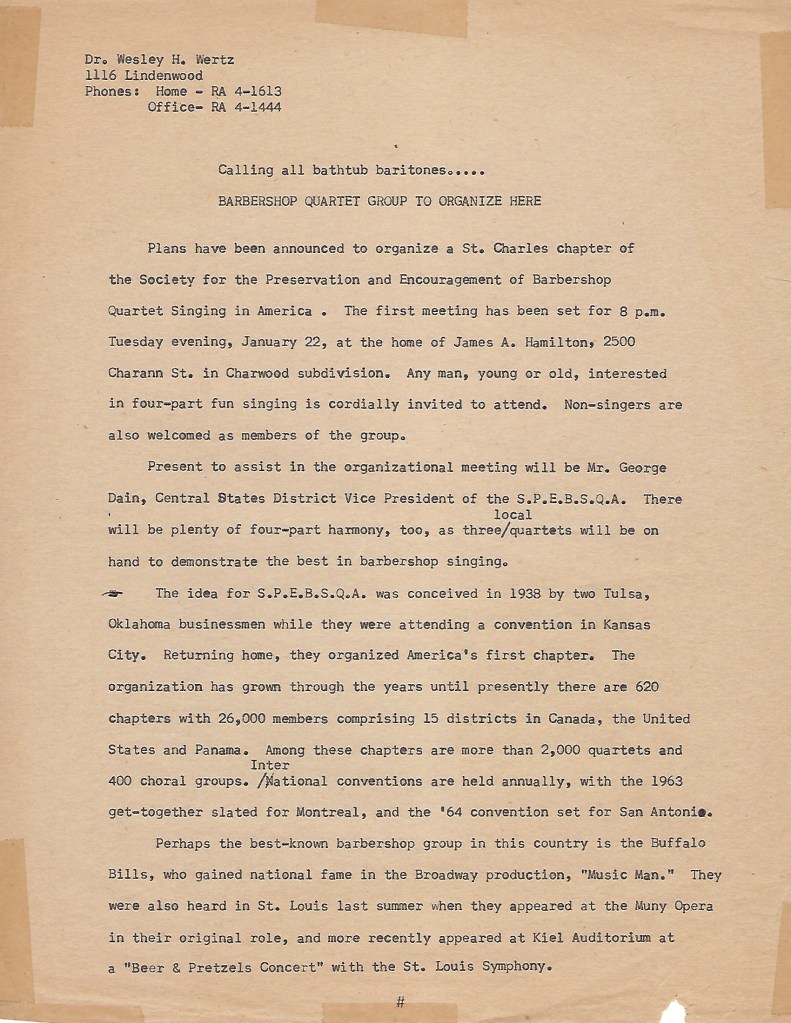
The current St. Charles Chapter of the S.P.E.B.S.Q.S.A., Inc. was founded in 1963, when a call went forth with the colorful introductory statement: “Calling all bathtub baritones.”

Announcement of the formation of a barbershop chapter in St. Charles (AOH Archives)

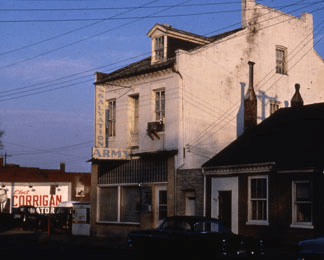
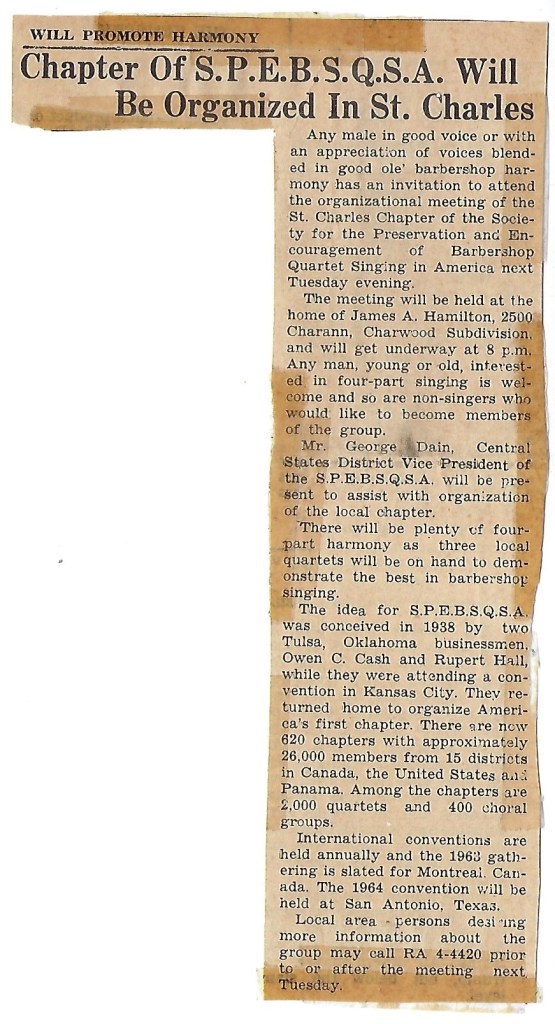
  The first meeting of the new Daniel Boone Chorus occurred 22 January 1963 at the home of James “Jim” Hamilton.[1]  The first director was Walter Gordon “Gordon” Manion (1928-2012).  He directed the chorus from January 1963 to October 1971.  The first chorus rehearsals were held at the Salvation Army Hall at 416 South Main Street in St. Charles (today’s Riverside Sweets). [2]

416 South Main Street, when it was home to the Salvation Army (1966)

Photo from the Archie Scott Collection, SCCHS, posted on the Preservation Journal

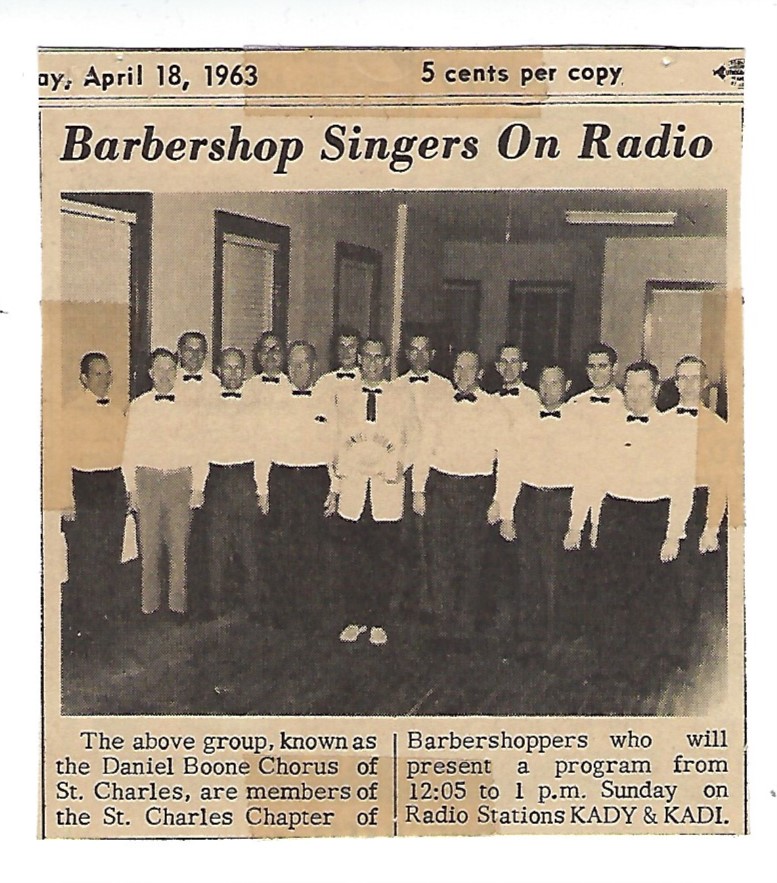
  The first officers were elected at the chapter meeting at the Salvation Army Hall on 5 February 1963.[3]  The chapter was officially incorporated on 7 February 1963.  The first chapter president was Bert Volker (1922-2007).  Doc Keough noted that Volker was responsible for holding the first meeting for the formation of the St. Charles Chapter of the S.P.E.B.S.Q.S.A.  “Volker was unanimously elected president, during which time he managed to get the chapter licensed and later chartered.”  Volker also served as assistant chorus director for the first few years.  He served on the St. Louis Area Barbershop Council and on the 1969 International Barbershop Convention Committee.  Volker sang in the Fargo (ND) Quartet before moving to St. Charles.  He sang with local quartets the Gay Blades from 1961 to 1965 and the Mutual Funs from 1970 to 1971.  The latter quartet performed as the quartet in “The Music Man” at the St. Louis Muny.  He was the chapter’s treasurer in 1971.  From 1972 to the end of the 1970s, Bert sang tenor with the Gaslight Squires.[4]  He was born in Tarkio, Missouri on 18 April 1922 and grew up in Tarkio.[5]  Volker began working in the airline industry after graduating from college in Tarkio.  He married C. Irene Dowden on 18 December 1943 in Maryville, Missouri.  At the time, Bert was assistant maintenance supervisor for Pella Airlines in Pella, Iowa.[6]  He worked for several airports before becoming Maintenance Inspector for the Federal Aviation Administration at Lambert-St. Louis International Airport.  Bert and Irene Volker and their family moved from Fargo, North Dakota to St. Charles, Missouri in September 1961.[7]  Bert Volker joined the S.P.E.B.S.Q.S.A. while living in Fargo, North Dakota, in 1959.  For over four decades, Irene Volker was responsible for the many non-tuxedo costumes worn by the Daniel Boone Chorus and the Ambassadors of Harmony.[8]  The first chapter secretary was Martin L. Hettich (1933-2003).[9]  An official slate of officers was elected in April 1963.  Volker was president, Daniel R. “Dan” Valasek (1933-2017) was vice-president of membership, Dr. Keim Lauderdale Baird (b. 1934) was vice-president of programming, Thomas Carl “Tom” Nelsen (b. 1938) was secretary-treasurer, Paul Joseph Boschert (1929-2013) was publicity chairman.  Other board members included Carl Matthew Daniel (1930-2000), Charles William Hafer (1917-2007), and Joseph Francis “Doc” Keough (1920-2010).[10]  The first chorus picture appeared in local newspapers in April. 

St. Charles Daily Banner-News, 17 January 1963 (AOH Archives)

St. Charles Journal, 18 April 1963 (AOH Archives)

In April 1963, rehearsals were moved to the American Legion Hall in St. Charles, where they continue to be held until 1969.  The chorus initially met on Wednesday evenings at 8:15 p.m. at the American Legion Hall at Third and Washington streets.[11] 

St. Charles County Historical Society Photo 232.0127, American Legion Post 312 HQ, 1946

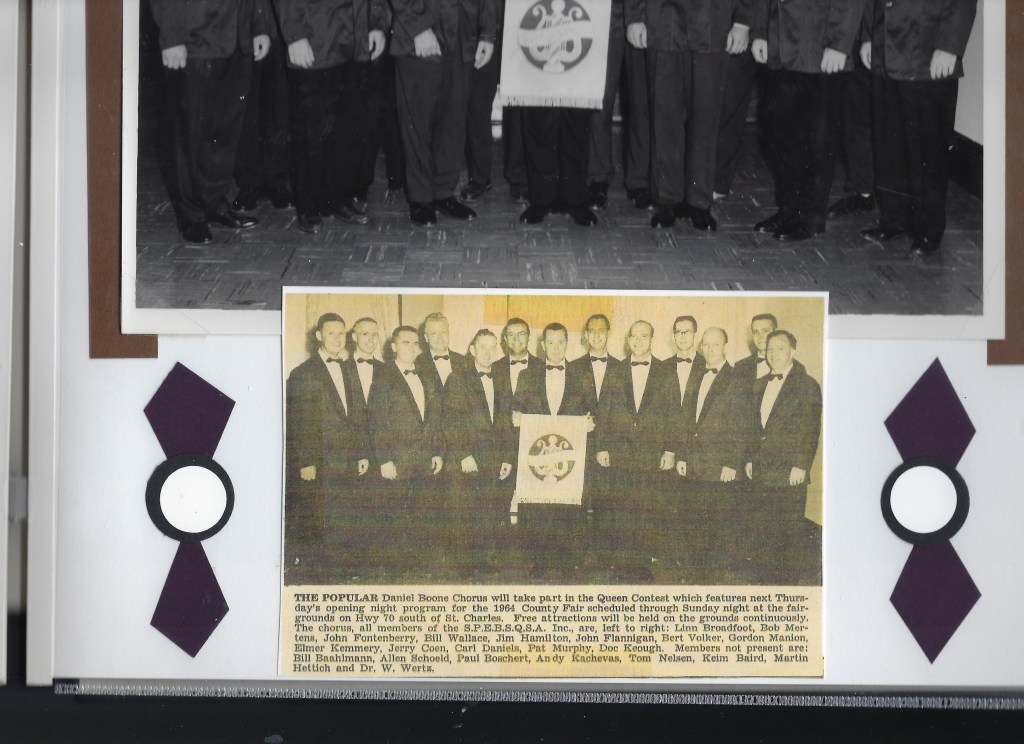
The first performance of the chapter was recorded on 19 March 1963 at KADY and broadcast during Barbershop Harmony Week.  The name “Daniel Boone Chorus” was temporarily adopted by most of the chapter on 27 March 1963.[12]  The chorus provided a quartet for the St. Charles County Fair on 18 July 1963.[13]  The first public live performance of the Daniel Boone Chorus occurred on 23 September 1963 at the P.T.A. Meeting at Benton School in St. Charles.[14]  The St. Charles Chapter was incorporated by the chapter board on 11 December 1963.  Per the copy recorded at the St. Charles County Recorder of Deeds office, “The purpose for which this corporation is organized is to perpetuate the old American institution, the Barbershop Quartet, and to promote and encourage vocal harmony and good fellowship among its members; to encourage and promote the education of the public in music appreciation; and to promote public appreciation of Barbershop Harmony, and to exercise such other and further powers as are necessary to accomplishment of such purpose.”[15]  The chapter received its official charter from S.P.E.B.S.Q.S.A. on 28 December 1963.[16]

Official St. Charles Chapter S.P.E.B.S.Q.S.A. photo celebrating the charter (1964)

(AOH Archives)

                The first chapter show was on 25 April 1964 at St. Charles High School.  By this time, Dr. Baird was replaced by Carl Daniel as Vice-President of Programming.  James Hamilton, who hosted the first chapter meeting at his home on 22 January 1963, was now secretary and Tom Nelsen was now treasurer.  The program included performances by the chorus and the following quartets:  The Gay Blades (Allen Schoeld, Jim Hamilton, Bert Volker, Dr. Wes Wertz), The Big Muddy Four (Dr. J. F. Keough, W. Gordon Manion, Elmer Kemmery, Carl Daniel), The Gateway Four (Tom Nelsen, Dave Jones, Linn Broadfoot, Dr. Keim Baird), The Harmonites (Carl Herzog, Denim Franklin, Jack Fisher, Bob Hemmer), The Tri Towners, and the Key Pickers (Stan Johnson, George Ivanao, Al Boyd, Walter Pormann).[17]  The first edition of the Coonskin Cappers Weekly (published, ironically, monthly) appeared in July 1964.  The newsletter noted that J. W. “Pete” Campbell, who emceed the Charter Night show was transferred from Lambert Airport to the FAA Training Academy in Oklahoma City.  The chorus performed on 10 June for the Ladies’ Sodality of St. Charles Borromeo Catholic Church.  The Big Muddy Four, one of the chapter quartets, performed 16 June at the Chamber of Commerce Appreciation Dinner at the St. Charles Country Club and on 17 June for the St. Charles Jaycees Auxiliary Club.[18]

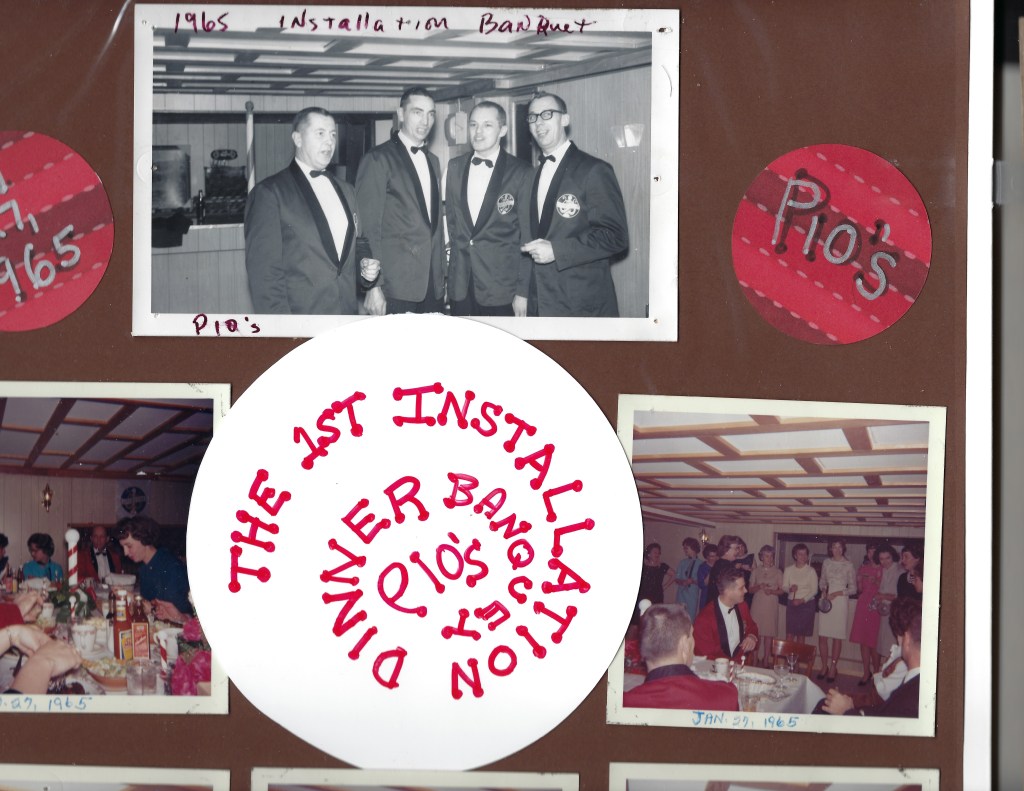
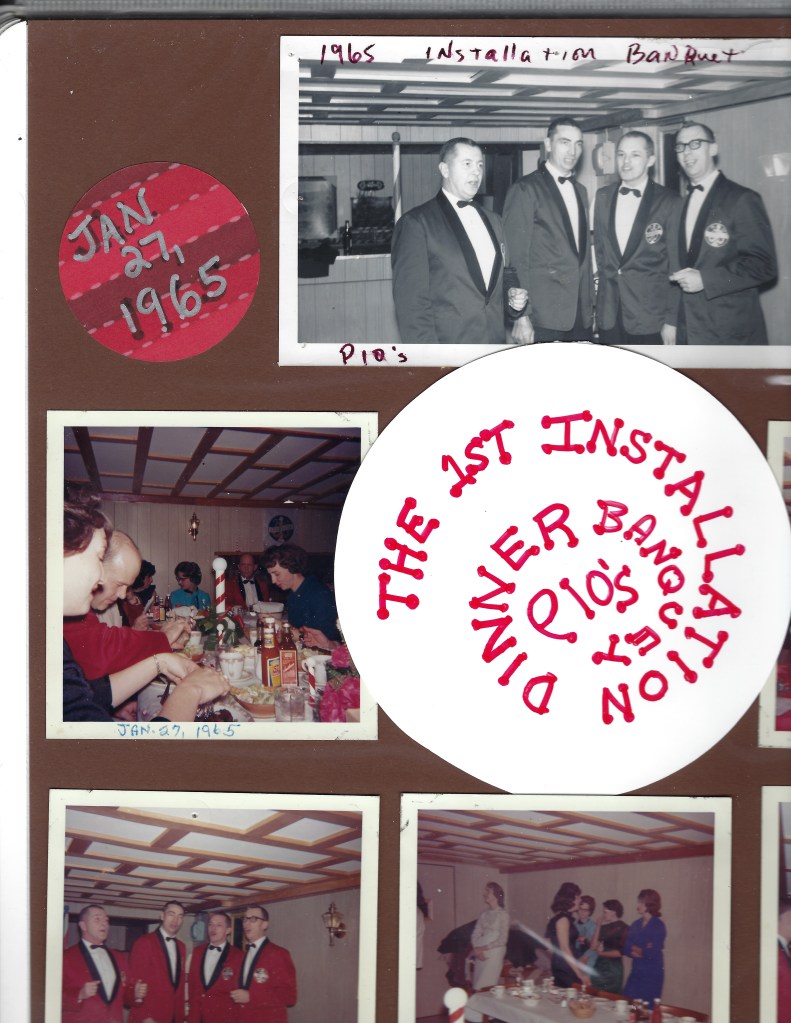
                The first Installation Banquet held by the chapter was at Pio’s Banquet Center in St. Charles, Missouri, on 27 January 1965.[19]  One could purchase a fried chicken dinner for $2.35 per person or a T-bone steak dinner for $3.25.  The bar opened at 7 p.m. and serving of food began at 8 p.m.  Gordon Manion directed the entertainment program, which featured several talented chorus members.  The ticket chairman was Bob Mertens.[20]

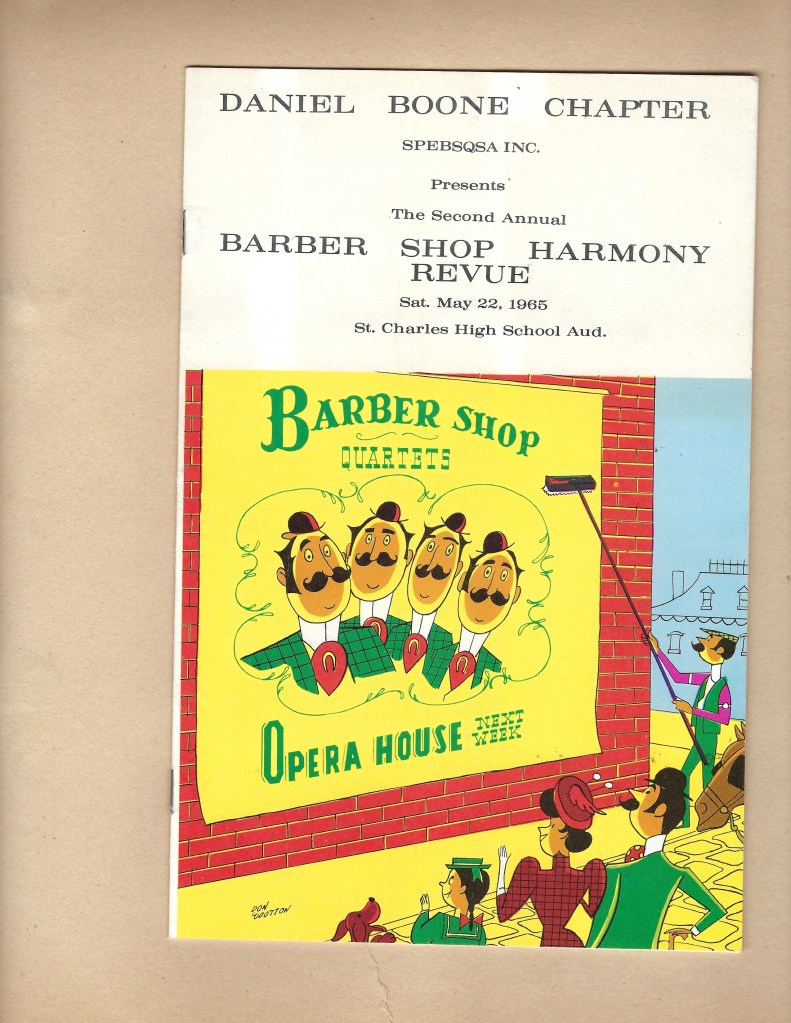
The new chorus president for 1965 was J. F. “Doc” Keough.  He first became involved in barbershop harmony in 1960, when he was a founding member of the quartet, the Charlestones.  The Charlestones, performed at the first chapter meeting on 22 January 1963.  He sponsored thirteen members of the chorus prior to the Barbershop Harmony Society instituting the “Man of Note” program.  Keough was responsible for the non-profit status of the chapter.  He was St. Louis Area Barbershop Counselor in 1966 and served on the 1969 International Barbershop Convention Committee as Registration Chairman.  Keough also sang in the Big Muddy Four (1963-1964), the Tic Tac Tones (1965), and the Quadri-Pals (1966-1971) quartets.  In 1965, the St. Charles Barber Shop Harmony Revue was made an annual event.  He was show chairman in 1964 and show co-chairman in 1965.  Keough served as Logopedics Chairman for the St. Charles Chapter, S.P.E.B.S.Q.S.A. from 1967 to 1971.  He was Program Vice-President in 1972 and also served several years as the chapter photographer.[21]  The Big Muddy Four (Carl Daniels, Dr. J. F. Keough, Gordon Manion, and Bert Volker) performed on “The Charlotte Peters Show” on 9 February 1965.[22]  The chorus performed at the Night of Harmony on Saturday, 6 March 1965.[23]  The first documented guest night was on 17 March 1965.[24]  The Daniel Boone Chorus performed at “Personally Yours” fashion show on 27 March 1965 at St. Charles Presbyterian Church.[25]  The chorus performed at the Trio Barber Shop in St. Charles on 3 April 1965.  The barbershop was located at the entrance to Trio Mobile Homes on Old Highway 40, just east of Zumbehl Rd.[26]  The chapter built a sign at the intersection of Harvester Road and West Clay Street in May 1965.[27]  The chorus held its Second Annual Barber Shop Harmony Revue on 22 May 1965 at the St. Charles High School auditorium.[28]

Second Annual Daniel Boone Chorus Spring Show, 22 May 1965 (AOH Archives)

The chorus competed at the Central States District for the first time in Des Moines, Iowa, in 1965.[29]

Carl Daniel, President of the St. Charles Chapter, S.P.E.B.S.Q.S.A., 1966, and namesake of the Carl Daniel Award 

               The chapter president for 1966 was Carl Daniel.  He was responsible for establishing “Barbershop Harmony Time,” a Sunday radio program which featured thirty minutes of quartets and choruses.  Daniel also served as St. Louis Area Barbershop Council President and arranged to have certified judges for area contests.  He was on the stage committee for the 1969 St. Louis Barbershop Harmony Convention.  Daniel served as chorus director from 1968 to 1971 and sang bass with the Quadri-Pals quartet.[30]  The 1966 Installation Banquet was at Bogey Hills Country Club.[31]  On 26 February 1966, the chorus held a variety show at the Orchard Farm High School Auditorium at 8 p.m.[32]  On 2 March 1966, the chorus performed in the Missouri Room at the Three Flags Restaurant.  The chorus sponsored a showing of the 1965 International Barbershop Quartet competition there.[33]  On 7 March, the St. Charles chapter received the Golden Note Award from S.P.E.B.S.Q.S.A. Executive Director Barrie Best.[34]  The accompanying letter explained that the award was sent to honor the achievement of 10%+ increase in membership.[35]  On 19 May 1966, the chorus performed for the St. Charles Community Council at Golf View Inn.[36]  In August 1966, the chapter held a swimming party.[37]  The chorus held its Third Annual Barber Shop Revue at the St. Charles High School Auditorium on 22 October 1966.  Featured guests were the Foremen, a barbershop quartet from Fort Dodge, Iowa.[38]  The emcee of the concert was Thom Lewis.[39]

                Jerry Coen was board president for the St. Charles Chapter of S.P.E.B.S.Q.S.A. in 1967 and 1970.  A native of Lima, Ohio, Coen worked in Alaska in the summer of 1953 while an engineering student and resident of Toledo, Ohio.[40]  Coen and his wife Shirley were members of St. Charles Presbyterian Church in St. Charles.[41]  He served on the organizing committee of the St. Charles County YMCA in 1968.[42]  He is known as a “quiet, hard-working guy.”  He was St. Charles Chapter Secretary from 1965 to 1966, Program Vice-President in 1969 and 1974, Area Council Representative in 1967, Area Vice-President from 1970 to 1971, and Area Councilor from 1972 to 1973.  He was Chairman of the St. Louis Area Barbershop Contest in 1970 and co-chairman of that contest in 1971.  He served as Assistant Chairman of the Scenery Committee for the 1969 St. Louis International Barbershop Convention and assisted in the airing of the WRTH Barber Shop Harmony Time series.  Coen sang baritone in several quartets, including Quadri-Pals (1965-71) and Men of a Chord (1971-1972).  He was a senior design engineer at McDonnell Douglas.  He and his wife, Shirley, have four children.[43]  Coen actively sang in the St. Charles Daniel Boone Chapter of S.P.E.B.S.Q.S.A. from 1963 to 2008.  The 1967 Installation Banquet was at Three Flags Center in St. Charles.[44]  In addition to Coen serving as president, other officers inducted were Reed Rings, vice-president for membership; Bob Henry, vice-president for programming; Neil Pierce, secretary; Gordon Manion, treasurer; Carl Daniel, bulletin editor; Bill Wallace, public relations offier; and John Fortenberry, chorus contact man.[45]  While Coen was serving as board president, the chorus received a proclamation from the City of St. Charles.  Mayor Henry C. Vogt declared 9-15 April 1967 “Barbershop Harmony Week” in St. Charles.[46]  Coen also spearheaded the chapter’s support of the Institute of Logopedics in Wichita, Kansas.[47]  Today, the institute continues to service children with special needs as Heartspring.[48]

Robert E. “Bob” Henry, President of the St. Charles Chapter, S.P.E.B.S.Q.S.A., 1968 

               In February 1968, the Installation Banquet was at Elm Point Steak House.  Plans were announced to compete in the district competition that fall in Kansas City, Missouri.[49]  Robert Elwin “Bob” Henry (1936-1980) was Board President in 1968.  Henry was born on 12 March 1936 in DeSoto, Missouri, to James Elwin Henry and Estelle M. (Wiley).[50]  He married Rose Marie Licavoli on 14 September 1957 in Overland, Missouri.[51]  Bob Henry joined S.P.E.B.S.Q.S.A. in 1965.  He served as Administrative Vice-President, Program Vice-President, and served four terms on the Board of Directors.  The Daniel Boone Chorus purchased its first complete chorus uniform and competed in the Central States District Chorus Competition in 1968.  Bob Henry was chosen for the district’s “Hustlin-Hundred” award.  He served on many show committees, was the Quartet Promotion Chairman, St. Louis Area Councilor for two terms, and the St. Louis Area Council President in 1970 and 1971.  He served on the Registration Committee for the 1969 International Barbershop Convention in St. Louis and hosted 1968 International Quartet Champions, the Western Continentals.  Bob sang lead in the Tic-Tac-Tones (1965), the Tune Capers (1966), the Mutual Funs (which appeared onstage at the Muny in “The Music Man” in the 1970s), and the Gaslight Squires.  He attended judge’s school and was a quartet coach.  Bob was known for his enthusiasm and drive which “made him one of the most respected members of the St. Charles chapter.”[52]  The chorus performed at the Veterans’ Hospital on 22 April 1968.[53]  On 31 July 1968, members of the Daniel Boone Chapter of the S.P.E.B.S.Q.S.A. performed at Memorial Hall in Blanchette Park at the meeting of the League of Women Voters of the St. Charles Area.[54]  A Labor Day 1968 “non-fishing trip” turned into an annual Labor Day Campout (a tradition that is still going on).[55]  There were other parties at the home of Bert Mueller and at the Coon Club.[56]  The Daniel Boone Chapter presented its Fifth Annual Barbershop Harmony Revue on Saturday, 21 September 1968, at 8 p.m. at the St. Charles High School Auditorium.[57]  The performance featured the quartet, the Foremen, from Rolfe, Iowa.[58]  21 September was a busy day for the chorus.  They also competed in the St. Louis Area Barbershop Chorus Contest at Florissant Valley and finished third.[59]  On 5 October 1968, the chorus finished twelfth in the Central States District Chorus Competition in Kansas City, Missouri.[60]  On 16 November, the chorus performed at a dance at the O’Fallon Civic Club Park in O’Fallon, Missouri.[61]  Members of the chorus presented their Top 21 Songs on 11 December.[62]  The earliest documented chapter Christmas party was on Wednesday, 18 December, at the home of Bert and Irene Volker.[63]

Larry White, St. Charles Chapter President, 1969, picture from chapter Groupanizer profile

                The president for 1969 was Larry White.  He joined the chapter in April 1968 and sang with the Ambassadors of Harmony until 2020.[64] He immediately became bulletin editor and a St. Louis Area Councilor.  He initiated a package show program and served on the registration committee for the 1969 International Barbershop Convention in St. Louis.  He has sung in the quartets Gad-A-Bouts, Mid-Western Union, Brass Tacks, and Male Call (along with John Huddle and Frank Cook).[65]  White was the co-Barbershopper of the Year in 2019.[66]  Other officers for 1969 were Neil Pierce, Administrative Vice-President; Jerry Coen, Program Vice-President; Bert Mueller, Secretary; Bill Morton, Treasurer; Bob Henry, Immediate Past President; Carl Daniel; Director; Carl Daniel and Bill Morton, Bulletin; Bob Henry and Wayne Ketteman, Contact; Doc Keough, Publicity.  The Installation Banquet in 1969 was on 18 January.[67]  The Daniel Boone Chorus performed at Bonfils Auditorium in Troy, Missouri, where they entertained the Claude Brown Elementary School Parent-Teachers Association on 28 March 1969.[68]  The chorus performed at the Jamboree at Waterloo, Illinois, on 30 April 1969.[69]  The chorus was still small at this time, averaging attendance of 15-20 men.  The St. Charles Chapter began actively recruiting more members and this began the increase in size in the chorus.[70]  The chapter held a guest night on 20 May 1969 at Three Flags Restaurant in St. Charles.[71]  They performed at St. Thomas More School on 14 June 1969 at a musical variety show to benefit the school’s athletic program.[72]  The chapter and some local Sweet Adelines had some fun in presenting a play in which a male and a female quartet participated.  The headline reads “Kangaroo Kourt finds Harmony Belles guilty of impersonating choral group.”[73]  The chorus moved rehearsals from the American Legion Hall to Station Duquette at Second and Adams streets in 1969.[74]  The American Legion “was not much” and had “no air conditioning.”  The chorus experienced “lots of Missouri summertime” at the American Legion Hall, including 100-degree heat “and about a million bugs!”

Station Duquette, located on Second Street (torn down in 1993, image from Pinterest)

  Station Duquette was described as “wonderful” and gave the chorus a chance to perform the chorus’ German verse of “Edelweiss” for the station’s German-speaking owner, Gus Holzwarth.[75]  “He listened politely, then asked what language we were singing!”[76]  The Daniel Boone Chorus finished seventeenth out of twenty-one choruses at the Central States District Chorus Competition in Omaha, Nebraska, on 18 October 1969.[77]  They also participated in the Fourth Annual St. Louis Area Barbershop Contest on 27 September 1969 at Kirkwood Community Center in Kirkwood, Missouri, where they finished third.[78]  The chorus held their annual Christmas party on 19 December.  Officers for 1970 were installed at the party.[79]  Fifteen members of the Daniel Boone Chorus sang Christmas carols to help raise $56.35 for the family of Lt. Albert Musterman, who was killed on 30 November 1969.  The fundraiser was held on 23 December 1969.[80]


[1] St. Charles Daily Banner-News, 17 January 1963, microfilm, KL-SCCCLD (also newspaper clipping in the Page-Schroer Collection in the Ambassadors of Harmony archives)

[2] Index card, Ed Page/Ken Schroer Collection, part of the Ambassadors of Harmony archives

[3] St. Charles Daily Banner-News, 1 February 1963, microfilm, KL-SCCCLD (also newspaper clipping in the Page-Schroer Collection in the Ambassadors of Harmony archives)

[4] Index card, Doc Keough Collection, Ambassadors of Harmony archives

[5] 1930 U.S. Census, www.ancestry.com, accessed 16 July 2020

[6] St. Joseph (MO) News-Press, 19 December 1943, Newspapers.com, accessed 16 July 2020

[7] Ruth Harlan, “Social Notes,” St. Charles Journal, 7 September 1961, Newspaper Archive, accessed 16 July 2020

[8] Index card, Doc Keough Collection, Ambassadors of Harmony archives; Irene Volker was still in charge of costuming for the chorus when Justin Watkins joined the chapter in 2003.  The chorus used handsewn vests made by her until the end of 2006, when new outfits were purchased.

[9] St. Charles Chapter (S.P.E.B.S.Q.S.A.) Articles of Incorporation, 7 February 1963, Ambassadors of Harmony archives

[10] April 1963 St. Charles newspaper clipping, Doc Keough Collection, Ambassadors of Harmony archives

[11] Ibid.

[12] St. Charles Chapter S.P.E.B.S.Q.S.A. Newsletter, 4 April 1963, Ambassadors of Harmony collection

[13] St. Charles Journal, 18 July 1963, Newspaper Archive, accessed 27 February 2018; Wentzville Union, 18 July 1963, Newspapers.com, accessed 25 December 2017

[14] St. Charles Journal, 19 September 1963, Newspaper Archive, accessed 27 February 2018

[15] St. Charles County (MO) Deed Book 402, p. 95, 11 December 1963

[16] Chapter charter is kept on file by the AOH Board Secretary

[17] Chapter charter program, 25 April 1964, Ambassadors of Harmony archives; Troy (MO) Free Press and Silex (MO) Index, 24 April 1964, Newspaper Archive, accessed 17 December 2018

[18] The Coonskin Cappers Weekly I, no. 1 (July 1964), Ambassadors of Harmony archives

[19] Ambassadors of Harmony archive, which includes pictures

[20] Letter from Doc Keough, president-elect, to the “Daniel Boone Chapter” of St. Charles, MO, 14 January 1965, Ambassadors of Harmony archives

[21] Index card, Ambassadors of Harmony archives

[22] St. Charles Journal, Thursday, 25 February 1965, Newspaper Archive; pictures from this performance are in the Daniel Boone Chorus binder, 1963-68, Ambassadors of Harmony archives

[23] Pictures in Daniel Boone Chorus binder, 1963-68, Ambassadors of Harmony archives

[24] Daniel Boone Chapter Newsletter, February 1965, Ambassadors of Harmony archives

[25] St. Charles Journal, 25 March 1965, Newspaper Archive

[26] Pictures in Daniel Boone Chorus binder, 1963-68, Ambassadors of Harmony archives; Chapter President’s Bulletin, 1965; some more pictures of this are in the Daniel Boone Chorus binder, 1970-71, Ambassadors of Harmony archives; Trio Mobile Home Park was closed in 1999 and rezoned commercial (St. Charles Post, 16 August 1999).  Lowe’s was built on the site in 2000 and continues in business at that location (St. Charles County Assessor’s Property Search Database).

[27] St. Charles Daily Banner-News, 13 May 1965, Daniel Boone Chorus binder, 1963-68, Ambassadors of Harmony archives

[28] Pictures of this performance are in the Ambassadors of Harmony archive; St. Charles Journal, 20 May 1965, Newspaper Archive; see program in Daniel Boone Chorus binder, 1963-68, Ambassadors of Harmony archives

[29] St. Charles Journal, 28 February 1972, Newspaper Archive

[30] Index card, Ambassadors of Harmony archives

[31] Pictures in Ambassadors of Harmony archives

[32] Program, Daniel Boone Chorus binder, 1963-68, Ambassadors of Harmony archives

[33] St. Charles Journal, 24 February 1966, Newspaper Archive

[34] Certificate, Ambassadors of Harmony archives

[35] Letter from Barrie Best, Executive Director of S.P.E.B.S.Q.S.A., to Carl Daniel, President, St. Charles, Missouri, Chapter, S.P.E.B.S.Q.S.A., 7 March 1966, Ambassadors of Harmony archives

[36] St. Charles Journal, 19 May 1966, Newspaper Archive

[37] Pictures in 1963-1968 DBC Binder, Ambassadors of Harmony archives

[38] St. Charles Journal, 20 October 1966, Newspaper Archive

[39] Daniel Boone Chorus 1963-68 binder, Ambassadors of Harmony archives

[40] Fairbanks (AK) Daily Miner, 6 July 1953, Newspaper Archive, accessed 18 July 2020

[41] “Tableau of Last Supper,” St. Charles Journal, 15 April 1965, Newspaper Archive, accessed 18 July 2020

[42] “New Members on YMCA Board,” Wentzville Union, 18 January 1968, Newspaper Archive, accessed 18 July 2020

[43] Index card, Ambassadors of Harmony archives

[44] Pictures, 1963-68 DBC binder, Ambassadors of Harmony archives

[45] St. Charles Daily Banner-News, January 1967, 1963-68 DBC binder, Ambassadors of Harmony archives

[46] Typescript of proclamation, Ambassadors of Harmony archives

[47] There is an entire section of the 1963-1968 Daniel Boone Chorus binder dedicated to this institute.  It was chosen as the International Service Project of the S.P.E.B.S.Q.S.A. in June 1964, Ambassadors of Harmony archives

[48] https://www.heartspring.org/about_us, accessed 31 December 2020

[49] St. Charles Journal, 15 February 1968, Newspaper Archive

[50] U.S. Social Security Applications and Claim Index, 1936-2007, www.ancestry.com, accessed 18 July 2020

[51] Missouri Marriage Records, 1805-2002, www.ancestry.com, accessed 18 July 2020

[52] Index card, Ambassadors of Harmony archives

[53] Picture, Ambassadors of Harmony archives with date and information

[54] Letter from Judith L. Turner to Roy Seigler, 1 August 1968, Daniel Boone Chorus binder, 1968-69, Ambassadors of Harmony archives

[55] Pictures of this are in the Daniel Boone Chorus binder, 1968-69, Ambassadors of Harmony archives

[56] Pictures in the Daniel Boone Chorus binder, 1968-69, Ambassadors of Harmony archives

[57] Ticket, Ambassadors of Harmony archives

[58] Letter from Perry W. Johnson, 29 August 1968, Daniel Boone Chorus binder, 1968-69, Ambassadors of Harmony archives

[59] Scoresheet, Daniel Boone Chorus binder, 1968-69, Ambassadors of Harmony archives

[60] St. Charles Daily Banner-News, October 1968, Daniel Boone Chorus binder, 1968-69, Ambassadors of Harmony archives

[61] O’Fallon (MO) Community News, November 1968, Daniel Boone Chorus binder, 1968-69, Ambassadors of Harmony archives

[62] Program in Daniel Boone Chorus binder, 1968-69, Ambassadors of Harmony archives

[63] Chorus newsletter, Daniel Boone Chorus binder, 1968-69, Ambassadors of Harmony archives

[64] Members.barbershop.org, accessed 20 July 2020

[65] Ibid. and Index card, Ambassadors of Harmony archives

[66] https://aoh.groupanizer.com/node/86816, accessed 22 July 2020

[67] Pictures and list are in Daniel Boone Chorus binder, 1968-69, Ambassadors of Harmony archives

[68] Troy Free Press and Silex Index (MO), 21 March 1969, Newspaper Archive; The Coonskin Capper’s Weekly VI, no. 2 (February 1969), Daniel Boone Chorus binder, 1968-69, Ambassadors of Harmony archives

[69] Pictures in the Daniel Boone Chorus binder, 1968-69, Ambassadors of Harmony archives

[70] Index card, Ambassadors of Harmony archives

[71] The Coonskin Capper’s Weekly VI:  no. 3 (May 1969); edited by Karl Bolton, Daniel Boone Chorus binder, 1968-69, Ambassadors of Harmony archives

[72] Program, Daniel Boone Chorus binder, 1968-69, Ambassadors of Harmony archives

[73] St. Charles Daily Banner-News, Friday, 15 August 1969, clippings in Daniel Boone Chorus binder, 1970-71, Ambassadors of Harmony archives

[74] Note card listing directors and rehearsal venues, Ambassadors of Harmony archives

[75] Last name taken from St. Charles Journal, 16 August 1976, Newspaper Archive, accessed 20 July 2020; Station Duquette was located at 325 N. Second Street.  It was later torn down by St. Charles County after the county purchased the site in 1984 from Frieda E. Lyons (Deed Book 988, p. 197).  Today, the site is occupied by the St. Charles County Jail (see St. Louis Post-Dispatch, 2 October 1988).

[76] Index card, Ambassadors of Harmony archives

[77] The Central States Serenade, no. 5 (December 1969), Ambassadors of Harmony archives

[78] Program in Ambassadors of Harmony archives; scoresheet, Daniel Boone Chorus binder, 1968-69, Ambassadors of Harmony archives

[79] Pictures in Daniel Boone Chorus binder, 1968-69, Ambassadors of Harmony archives

[80] “Munsterman Collection,” St. Charles Daily Banner-News, 24 December 1969, Daniel Boone Chorus binder, 1968-69, Ambassadors of Harmony archives

Barbershop Harmony (1890-1963)

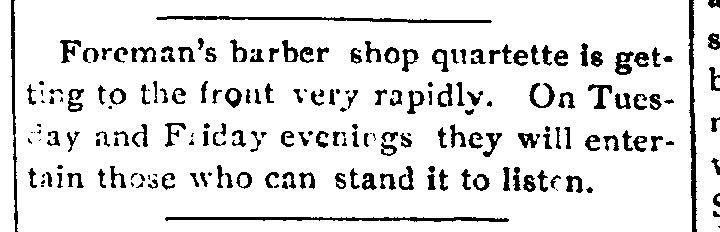
                The earliest reference to a barbershop quartet appears to have been in 1892.  The Decatur (IN) Daily Democrat comments, “Foreman’s barber shop quartette is getting to the front very rapidly.  On Tuesday and Friday evenings they will entertain those who can stand it to listen.”[1]

Decatur (IN) Daily Democrat, p. 1, 8 April 1892 (Newspaper Archive)

  Frank C. Foreman was born in July 1865 in Indiana and was a white barber living in Decatur, Indiana, in the 1900 U.S. Census.[2]  He later moved to Cincinnati, Ohio, where he died on 25 September 1929.  He was buried in Oxford Cemetery in Oxford, Ohio.[3]  This would seem to indicate that whites began to dabble in barbershop harmony by 1892.  In Scranton, Pennsylvania in 1893, “the barber shop quartette entertained the friends at the home of Jonas Allen yesterday afternoon and sang several selections in a pleasing manner.”[4]  Most references to a barbershop quartet at this time were for singing quartets, with one exception.  In Atchison, Kansas, in 1893, “The Barber Shop Quartette gave a concert Saturday on a violin, organ, banjo, and guitar.”[5]  A black barbershop owner, who was the leader of a black quartet in St. Louis, was solicited by one Cresswell, the organist of the First Presbyterian Church of St. Louis, to show off the new organ at the church.  The idea was to have the man sing when the organist pulled a string attached to the Vox Humana stop on the organ.  Unfortunately, by the time the organist tried to demonstrate for the people he invited to listen to the organ, the black man had fallen asleep inside!  The organist gave several tugs on the string, the last one so violently that it knocked Cresswell off the bench.  This awakened the black man, who cursed at being awakened!  “You deserve to win your bet.  You certainly have a wonderful instrument here.  I have heard Vox Humana pipes that could sing, but this is the only one I ever knew that could curse,” retorted one of the individuals called upon to judge the performance of the organ.[6]

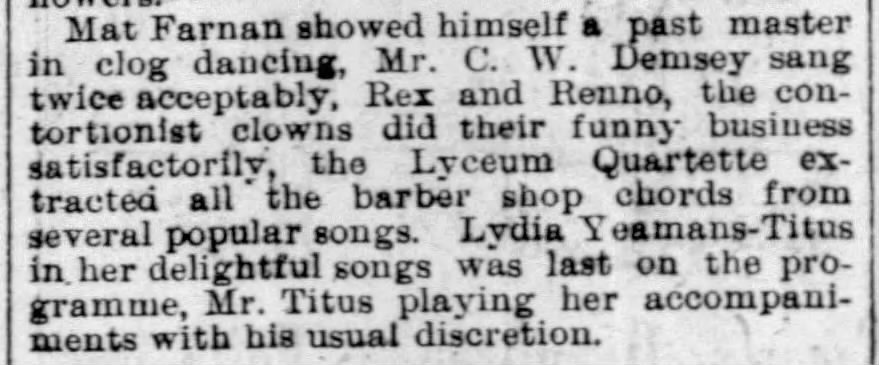
                The first references to barbershop chords also come from the 1890s.  “The Lyceum Quartette extracted all the barber shop chords from several popular songs,” announced the Buffalo (NY) Enquirer in 1893.[7]

Buffalo (NY) Enquirer, 13 June 1893, p. 5 (Newspapers)

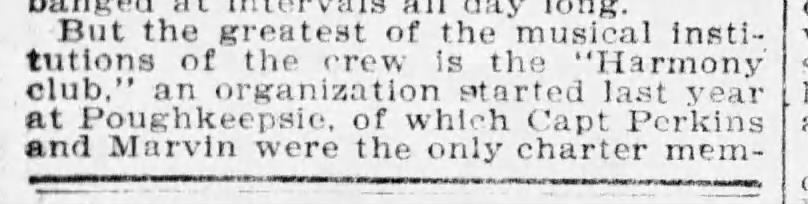
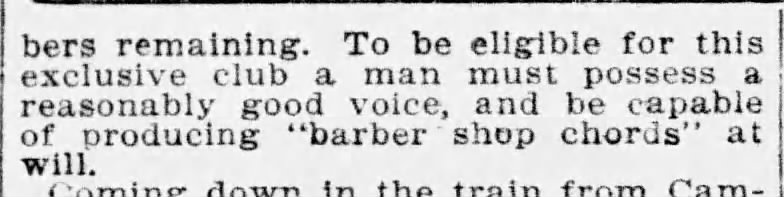
The earliest organized group which required the ability to sing barbershop chords for membership was the Harmony Club of Poughkeepsie, New York, formed in 1897:  “To be eligible for this exclusive club, a man must possess a reasonably good voice, and be capable of producing ‘barber shop chords’ at will.”[8]

Boston (MA) Globe, 12 June 1898, p. 16 (Newspapers)

The harmony club brings out another cultural contribution to barbershop harmony: the Germans. The existence of clubs can be seen in early nineteenth century newspapers, such as the mention of the Harmony Club in Hamburg, Germany, which was closed for a period of time in 1814 (The Freeman’s Journal [Dublin, Ireland], 10 January 1814, p. 3, Newspapers, accessed 4 July 2023). German immigration to the United States in the 1830s and 1840s led to the establishment of harmony clubs amongst German-American communities. The Gesang-Verein Harmonie Club was founded in Detroit in 1849 and started with ten members who all knew German lieder (art songs). The club continued to exist until 1974 (https://historicdetroit.org/buildings/the-harmonie-club). Not all German harmony clubs were centered on music. Some were social clubs for Germans, such as the one founded in 1852 in New York City (https://www.nyhistory.org/community/harmonie-club). Another harmony club that was focused on music was the Augusta Harmonie Verein in Augusta, Missouri. Founded on 13 January 1856, the Augusta Harmonie Verein was devoted primarily “to music and good fellowship” (https://www.artbybryanhaynes.com/shop/augusta-harmonie-verein/; “Early German Settlers Found Way to Get Around Temperance Laws,” Washington (MO) Missourian, 16 June 1955, p. 17, Newspapers, accessed 4 July 2023). The group performed at the annual festivals in Augusta (Anita M. Mallinckrodt, “145 Years of German-American Fests,” St. Charles County Heritage XIX (no. 4): 125 (October 2001).) The Augusta Harmonie Verein disbanded in 1922 (“Augusta Celebrates and Launches Revitalization of Harmonie Verein,” Boone Country Connection, 31 January 2020, https://boonecountryconnection.com/news/community-interest/7241-augusta-celebrates-and-launches-revitalization-of-harmonie-verein, accessed 4 July 2023). A men’s choir (männerchor) was founded in Augusta in 1882 and they celebrated their second anniversary on 13 May 1884 with “instrumental and vocal entertainment with some theatrical pieces, and an appropriate quantity of refreshments, which last is not to be avoided” (St. Charles Cosmos, 7 May 1884, p. 4, Newspapers, accessed 4 July 2023). The men’s choir continued to perform as late as 1897 (Marthasville (MO) News, 8 April 1897, p. 4, Newspapers, accessed 4 July 2023). Although harmony clubs existed throughout the United States and in many places in Missouri (including Sedalia, Missouri, see Cole County Democrat [Jefferson City, MO], 4 January 1889, p. 1, Newspaper Archive, accessed 4 July 2023), none seemed to sing barbershop harmony or require it except for the one mentioned earlier in Poughkeepsie, New York. The quartet clubs and harmony clubs were predecessors to barbershop chapters in the sense that neither quartet clubs nor harmony clubs required singers to be trained vocalists in order to participate.

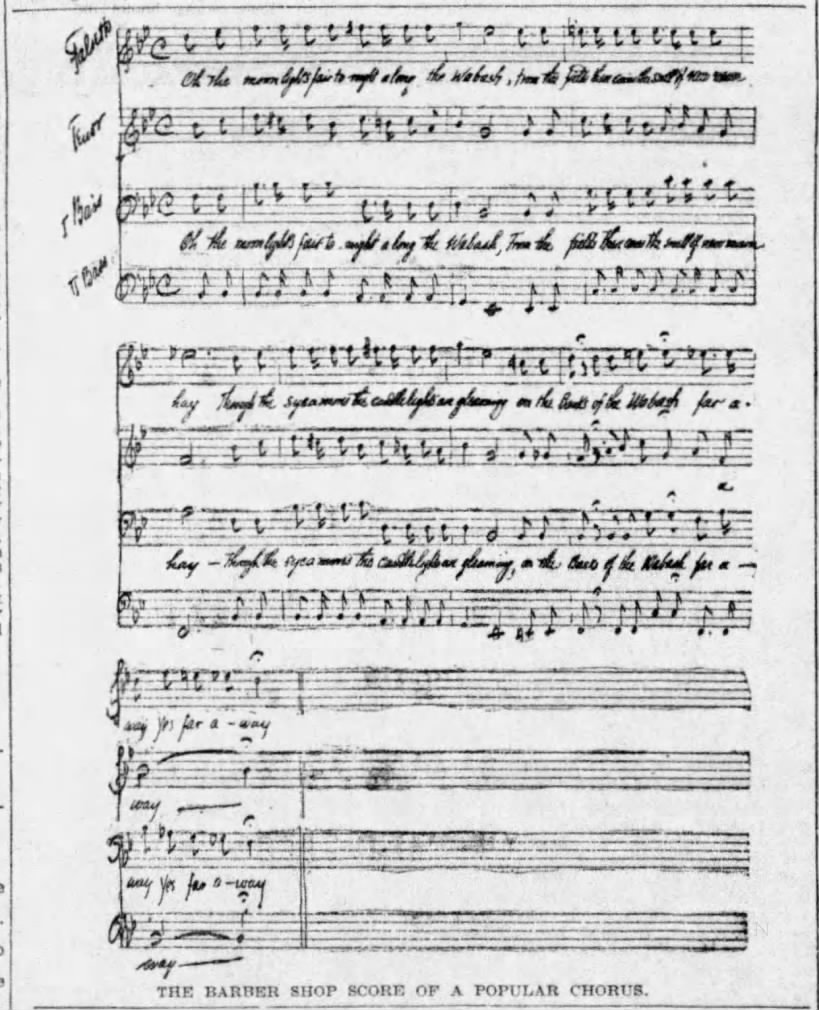
  The earliest barbershop arrangement to appear in print was that of “On the Banks of the Wabash,” which accompanied a full-scale description of barbershop harmony, entitled “Barber Shop Chords,” in the Kansas City (MO) Star, in 1899.

Kansas City (MO) Star, 7 May 1899, p. 7 (Newspapers)

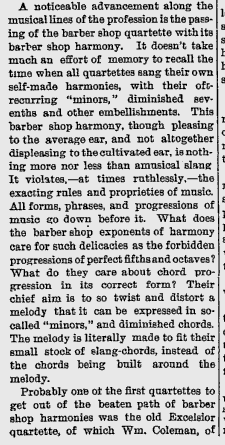
  The article points out that both whites and blacks were singing in barbershop quartets, but the author preferred the black barbershop singers to the white ones: “The Negro is the champion chord singer, however.  A quartette of Negro waiters sitting on the back steps of a hotel on a moonlit night can do more to make one glad that music was invented than Theodore, Thomas, or Sousa, or any of them.  They discover music as they go along.  They start out on the chorus of a song and on the third note find that it has fine possibilities for making a chord …”[9] Not everyone was fond of barbershop music. Ragtime music was criticized as being simple by an unnamed man in Chicago in 1899: “The formula for writing this sort of stuff is two bars of overcoat music and four barbershop chords.” The man then went on to explain that those who played ragtime often had the music stuffed in their overcoats before they performed (Marion County [MO] Herald, 4 May 1899, p. 7, Newspapers, accessed 4 July 2023).  The following year, “Tom the Tattler” wrote an obituary for the barbershop quartet in the Indianapolis (IN) Freeman: “A noticeable advancement along the musical lines of the profession is the passing of the barber shop quartette with its barber shop harmony.”  The author went on to describe barbershop chords as “a musical slang” which “violates—at times ruthlessly—the exacting rules and proprieties of music.”[10] 

Indianapolis (IN) Freeman, 8 December 1900, p. 2 (Google News Archive)

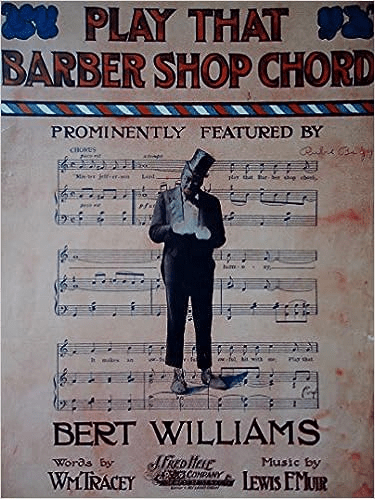
This 1900 obituary of barbershop harmony turned out to be quite premature! Prior to the above discovery, it was thought that the earliest reference to barbershop chords was the song, “Play that Barber Shop Chord” by Lewis Muir, recorded in 1910 by Bert Williams (https://www.youtube.com/watch?v=b1OOF4i2Noc, accessed 17 July 2023).

                The earliest documented quartet in St. Charles, Missouri, was the male quartet of the St. Charles College, which performed at the Odd Fellows Hall in St. Charles in June 1881 (St. Charles Cosmos, 15 June 1881, p. 1, Newspapers, accessed 4 July 2023). Churches also had male quartets, such as that formed by the Jefferson Street Presbyterian Church.  They performed for the Ladies’ Aid Society of the church at the home of Mrs. E. G. Ferguson on Jefferson Street in 1904.[11]  Although there are no references to barbershop quartets in St. Charles at the time, barbershop quartets were found in St. Louis throughout the first few decades of the twentieth century.  A barbershop quartet performed at the fall meeting of the City Club “Snoopers” in the Victoria Theater on 2 December 1914.[12]

                Barbershop quartets did not entirely fizzle out, but vaudeville (which was the primary outlet for barbershop quartets) was on the wane in influence by 1938.  The Society for the Preservation and Encouragement of Barber Shop Quartet Singing in America, Inc. was founded on 11 April 1938 in Tulsa, Oklahoma, by Owen Clifton Cash and Rupert Hall.[13]  Two months later, the first barbershop chapter in St. Louis, St. Louis No. 1, was founded.[14]  The first convention of S.P.E.B.S.Q.S.A. was held in Tulsa, Oklahoma, the first week of June in 1939.[15]  The fledgling society had its first controversy at its annual convention in 1941, held at the Coronado Hotel in St. Louis.  A quartet from New York was rejected due to being African American.  Owen Cash’s official note on 27 June 1941 to James V. Mulholland, Director of Recreation of the Department of Parks for the City of New York, stated that the board of directors of S.P.E.B.S.Q.S.A. decided in 1940 “that to keep down any embarrassment we ought not to permit colored people to participate.”  New York City Park Commissioner Robert Moses replied to Cash, “that if American ballads of Negro origin are to be ruled out of barber shop singing, most of the best songs we have will be blacklisted.  There was a man named Stephen Foster who never hesitated to acknowledge his debt to the Negroes for the best of his songs.”  Moses and New York Governor Alfred E. Smith left the S.P.E.B.S.Q.S.A. over the banning of this quartet to represent New York at the barbershop music convention in St. Louis.[16]  Cash thought blacks should form their own auxiliary organization of barbershop singers.[17]  The ban on black membership in S.P.E.B.S.Q.S.A. was lifted in 1963.[18]

                While barbershop harmony was striking chords in St. Louis, the town of St. Charles did not have its own barbershop chapter. However, barbershop music was not without its cameo appearances. The top KMOX Barber Shop Male Quartet performed at St. Charles High School in St. Charles on 10 February 1944 (St. Charles Cosmos-Monitor, 19 January 1944, p. 3, Newspapers, accessed 4 July 2023). The St. Charles Cosmos-Monitor invited its readers to join the S.P.E.B.S.Q.S.A. if they were “males, free, white, twenty-one” and “can sing–and those who can’t” (“St. Charles Citizens Invited to Join Barber Shop Quartet,” St. Charles Cosmos-Monitor, 16 August 1944, p. 5, Newspapers, accessed 4 July 2023). All Saints’ Dramatic Club in St. Peters performed at Francis Howell High School in Weldon Spring, Missouri, in 1944. The club featured its own barbershop quartet! (St. Charles Cosmos-Monitor, 8 November 1944, p. 5, Newspapers, accessed 4 July 2023).  A barbershop quartet affiliated with S.P.E.B.S.Q.S.A. performed at the Kiwanis Club’s meeting at the V.F.W. Hall at Fourth and Jefferson streets in 1950 (“Ray Barklage Heads Kiwanis,” St. Charles Banner-News, 19 January 1950, p. 1, Newspapers, accessed 4 July 2023). Attempts to start a barbershop chapter in St. Charles seem to have begun after World War II.  The St. Louis and Clayton chapters of S.P.E.B.S.Q.S.A. performed at the V.F.W. Hall in St. Charles at a meeting in view of creating a St. Charles chapter in 1950.  City Councilman Harold H. Linhoff was elected temporary chairman. [19]  Dr. Lustig of Lindenwood College was selected as musical director for the chapter two weeks later.[20] The Friedens 4-H Club and Extension Club entertained about eighty people with a performance that included a barbershop quartet in 1951 (St. Charles Cosmos-Monitor, 4 April 1951, p. 4, Newspapers, accessed 4 July 2023).  A second attempt to found a chapter was spearheaded by Ted Huesemann of St. Charles in 1958, but this attempt also failed.[21]  Apparently, there was not enough interest and St. Charles still did not have a chapter. A barbershop quartet performed at a picnic in O’Fallon, Missouri, put on as a benefit for playground improvement at the O’Fallon ballpark, which was located just east of the Forest Park subdivision, in 1960 (O’Fallon [MO] Community News, 28 July 1960, p. 1, Newspapers, accessed 4 July 2023). Although barbershop quartets were now appearing in St. Charles County, it was not until 1963 when a lasting barbershop chapter was formed.

The St. Charles Chapter of the S.P.E.B.S.Q.S.A., Inc. was founded in 1963, when a call went forth with the colorful introductory statement: “Calling all bathtub baritones.”  With that, barbershop harmony officially arrived in St. Charles to stay.


[1] Decatur (IN) Daily Democrat, 8 April 1892, Newspaper Archive, accessed 27 February 2018

[2] Ancestry.com. 1900 United States Federal Census [database on-line]. Provo, UT, USA: Ancestry.com Operations Inc, 2004.  Accessed 1 July 2020

[3] https://search.ancestry.com/cgi-bin/sse.dll?viewrecord=1&r=an&db=FindAGraveUS&indiv=try&h=148058849, accessed 1 July 2020

[4] Scranton (PA) Republican, 16 May 1893, Newspapers.com, accessed 27 February 2018

[5] Atchison (KS) Weekly Graphic, 29 April 1893, Newspapers.com, accessed 17 December 2018

[6] St. Louis Post-Dispatch, 4 November 1894, Newspapers.com, accessed 17 December 2018

[7] Buffalo (NY) Enquirer, 13 June 1893, Newspapers.com, accessed 1 July 2020

[8] Boston Globe, 12 June 1898, Newspapers.com, accessed 1 July 2020

[9] Kansas City (MO) Star, 7 May 1899, Newspapers.com, accessed 1 July 2020

[10] Indianapolis (IN) Freeman, 8 December 1900, Google News, accessed 11 July 2020

[11] St. Charles (MO) Daily Banner-News, 13 April 1904, on microfilm at Kathryn Linnemann Branch, St. Charles City-County Library District

[12] St. Louis Star-Times, 21 November 1914, Newspapers.com, accessed 31 July 2019

[13] https://www.barbershop.org/about/history-of-barbershop/the-history-of-the-society, accessed 2 July 2020

[14] St. Louis Post-Dispatch, 16 June 1938, Newspapers.com, accessed 21 November 2019

[15] Hutchinson (KS) News, 3 June 1939, Newspaper Archive, accessed 27 February 2018

[16] “Negro Singers Out, Smith, Moses Quit,” New York Times, 3 July 1941, ProQuest Newspapers, accessed shortly after the article based on this newspaper account appeared in The Harmonizer.

[17] “Al Smith Takes Another Walk Because Singers Bar Negroes,” St. Louis Globe-Democrat, 3 July 1941

[18] Dr. Jim Henry, “Roots of Barbershop Harmony,” The Harmonizer LXI, no. 4 (July 2001):  15

[19] “Councilman Heads Male Sing Group,” St. Charles Banner-News, 21 March 1950, KL-SCCCLD microfilm

[20] “SPEBSQSA Meeting,” St. Charles Banner-News, 3 April 1950, KL-SCCCLD microfilm

[21] “SPEBSQSA?” St. Charles Daily Banner-News, 26 May 1958, KL-SCCCLD microfilm

Precursors to Barbershop Music

NOTE:  This is part one of a series of articles based on the original, which was published at www.aoh.org in October 2013. The material below has been revised and updated by the author beginning in July 2020 to reflect new research and developments that have occurred since the fiftieth anniversary of the St. Charles Chapter of the S.P.E.B.S.Q.S.A. (Barbershop Harmony Society). In 2023, the chapter changed its name to Harmony STL.  Unless otherwise indicated, all pictures are from the archives of the Ambassadors of Harmony.

            You are standing on a set of risers; your heart is pumping.  The crowd starts to chant “A-O-H,” “A-O-H.”  The announcement begins … “Representing the Central States District …” The rest is muffled by the crowd cheering in anticipation of 160 men who are about to perform two songs.  Suddenly, the curtain rises, and you are greeted by a sea of people and a set of tables where there are seated fifteen men about to judge your performance.  The two songs go by quickly.  Then, at the last chord of the last song, the crowd suddenly gets out of their seats and cheers and claps.  The curtain falls and the cheering eventually dies down.  You catch your breath as you walk off the stage.  This was my experience when I first competed with the Ambassadors of Harmony in 2004 at the International Barbershop Convention in Louisville, Kentucky.  This was the first gold medal earned by the Ambassadors of Harmony; but the road to gold at the International Barbershop Convention had many twists and turns.

            The Ambassadors of Harmony is the men’s chorus of the Harmony STL (formerly St. Charles) Chapter of the Barbershop Harmony Society.  The BHS was originally founded in 1938 as the Society for the Preservation and Encouragement of Barber Shop Quartet Singing in America, Inc. (S.P.E.B.S.Q.S.A.) [1] The roots for the tuning of barbershop chords go back to Pythagorean tuning and just intonation.  In both cases, ratios are used to determine pitches.  The proper ring is achieved by locking chords.[2] Barbershop harmony appears to have roots in the development of quartet clubs in the United Kingdom and the United States in the early nineteenth century.  As early as 1836, the Blackburn Quartetto Club of Blackburn, England, was providing performances.[3]  The first quartet club in the United States appears to have been the Boston Quartette Club, which performed in Brattleboro, Vermont, on 29 August 1839.  They performed several classical works for their audience.[4]  Early quartet clubs sang classical music, but that changed as the United States began to develop its own popular music.  The music of black Americans was celebrated in the 1847 publication, The Ethiopian Glee Book, a book written for quartets.[5]  The book contained songs sung by the Christy Minstrels “with many other popular Negro melodies, in four parts, arranged for quartet clubs.”[6]  The quartet clubs appear to have been groups of amateur singers, such as those who sang in the Quartette Club of Madison, Indiana in 1852.[7]  In St. Louis, a group of blacks formed their own quartet club shortly after the end of the Civil War.  They were hired to sing love songs to a young black lady, but their singing attracted the attention of several other black ladies in the neighborhood.[8]  The hiring of black quartets by blacks and whites was apparently more and more common in the 1870s.  “The latest agony in the serenading line is to employ a negro quartette to do the singing and playing while the ‘feller’ places himself near the window to catch the coquet as it is gently dropped by his fair one,” lamented the Wichita (KS) Eagle in 1874.[9]  The newspaper in Austin, Texas, had a more favorable opinion of the black quartet that performed in their office in 1883:  “The Statesman office was favored with a serenade by the negro quartette of ‘A Mountain Pink’ company last night.  They are excellent singers and the songs highly pleased all.”[10]  The Harrison and Morton Quartette performed at a Republican campaign rally in Coronado, California, in 1888.[11]  Another black quartet performed at the city jail in St. Joseph, Missouri, that year.[12]

            The influence of African Americans on barbershop music has been extensively documented by Lynn Abbott in his article “Play That Barber Shop Chord.”[13]  According to Abbott, James Weldon Johnson (1871-1938) wrote: “In the days when such a thing as a white barber was unknown in the South, every barber shop had its quartet, and the men spent their leisure time playing on the guitar… and ‘harmonizing.’ I have witnessed some of these explorations in the field of harmony and the scenes of hilarity and backslapping when a new and rich chord was discovered. There would be demands for repetitions and cries of, ‘Hold it! Hold it!’ until it was firmly mastered. And well it was, for some of these chords were so new and strange for voices that, like Sullivan’s Lost Chord, they would have never been found again except for the celerity in which they were recaptured. In this way was born the famous but much abused ‘barber-shop chord.’”[14]

            An example of the type of barbershop music that Johnson might have heard can be found in renowned ragtime pianist Scott Joplin’s (1868-1917) opera Treemonisha.[15]  Joplin had his own touring quartet, The Texas Medley Quartette, an all-African American quartet that performed throughout the United States.  In 1893, the group consisted of Pleasant Jackson, first tenor; Scott Joplin, second tenor; Richard Denson, baritone; and Grant Miner, bass.  They stopped by the office of the Cedar Rapids (IA) Gazette and performed for the employees of the newspaper in August 1893.[16]  They received rave reviews in St. Paul, Minnesota, when they came to town there to perform, “The Texas Medley quartette is in town, and is giving some splendid vocal music in the public buildings and in office buildings having large courts.”[17]  In 1894, it was reported that the quartet had “won a wide reputation through the west during the past six years.”[18]  The influence of barbershop on ragtime can be seen by some of the chord progressions and constructions in Joplin’s most famous rag, “Maple Leaf Rag,” and in his opera, “Treemonisha.”  Barbershop also influenced another important American music genre, jazz.  In 2019, Dr. Vic Hobson wrote Creating the Jazz Solo:  Louis Armstrong & Barbershop Harmony, in which Hobson argues that Armstrong’s experience in quartet singing influenced the type of jazz Armstrong later played.[19]  This led to a discussion involving Hobson, Dr. David Wright, and the quartet Crossroads at the Satchmo Summer Fest held by the French Quarter Festivals, Inc. in New Orleans, Louisiana on Saturday, 3 August 2019.[20]  The impact of quartet singing on the music of Scott Joplin and Louis Armstrong points toward barbershop music as being at the center of the development of both ragtime and jazz.[21]


[1] https://www.barbershop.org/about/history-of-barbershop/the-history-of-the-society, accessed 1 July 2020

[2] http://www.medieval.org/emfaq/harmony/pyth2.html, accessed 1 August 2020; http://www.kylegann.com/tuning.html, accessed 1 August 2020

[3] Blackburn [UK] Weekly Standard and Express, 1 June 1836, Newspapers.com, accessed 19 December 2018

[4] Vermont Phoenix (Brattleboro, VT), 30 August 1839, Newspapers.com, accessed 19 December 2018

[5] Hartford (CT) Courant, 17 November 1847, Newspapers.com, accessed 19 December 2018

[6] The Ethiopian Glee Book (Boston, MA:  Elias Howe, 1848), title page; https://archive.org/details/ethiopiangleeboo1848howe, accessed 11 July 2020

[7] Madison (IN) Daily Madisonian, 26 February 1852, Newspaper Archive, accessed 19 December 2018

[8] Hartford (CT) Courant, 22 August 1866, Newspapers.com, accessed 17 December 2018

[9] Wichita (KS) Eagle, 3 September 1874, Newspapers.com, accessed 17 December 2018

[10] Austin (TX) American-Statesman, 13 October 1883, Newspapers.com, accessed 17 December 2018

[11] Coronado (CA) Mercury, 4 September 1888, Newspaper Archive, accessed 17 December 2018

[12] St. Joseph (MO) Gazette-Herald, 1 July 1888, Newspapers.com, accessed 17 December 2018

[13] Lynn Abbott, “Play That Barber Shop Chord,” American Music (Fall 1992), https://composerjude.com/wp-content/uploads/2016/02/Play-That-barbershop-Chord.pdf#:~:text=%22Play%20That%20Barber%20Shop%20Chord%22%3A%20A%20Case%20for,of%20barbershop%20harmony%20is%20couched%20in%20a%20roman-, accessed 9 July 2020

[14] James Weldon Johnson and J. Rosamond Johnson, American Negro Spirituals (New York:  Viking Press), 35-36, quoted in Abbott

[15] David Wright, “The African-American Roots of Barbershop (and Why It Matters),” Harmonizer LXXV, no. 1 (Jan-Feb 2015):  12, http://harmonizer.s3.amazonaws.com/Harmonizer_vol75_no1_janfeb2015.pdf, accessed 9 July 2020; for a clip of this, watch https://www.youtube.com/watch?v=lMMRGcM-pvk, 8 January 2015

[16] Cedar Rapids (IA) Gazette, 22 August 1893, Newspapers.com, accessed 29 July 2020

[17] St. Paul (MN) Globe, 2 November 1893, Newspapers.com, accessed 29 July 2020

[18] Marshfield News and Wisconsin Hub (WI), 12 April 1894, Newspapers.com, accessed 29 July 2020; for more information, see https://syncopatedtimes.com/scott-joplins-forgotten-parlor-songs/, accessed 29 July 2020

[19] Neal Siegal, review of Creating the Jazz Solo:  Louis Armstrong and Barbershop Harmony in The Syncopated Times, 25 February 2019, https://syncopatedtimes.com/creating-the-jazz-solo-louis-armstrong-barbershop-harmony/, accessed 31 July 2020

[20] https://www.youtube.com/watch?v=bI4K6hrzICY, accessed 31 July 2020

[21] Further development is needed on the ragtime and barbershop connection, but that is beyond the purview of this article

Sage Chapel Cemetery and Rev. Jefferson Franklin Sage

NOTE: This is an excerpt from a larger research project concerning Sage Chapel Cemetery in O’Fallon, Missouri.

                The name Sage Chapel has been much debated.  The name may have come from the sage fields that grew behind the church near Sonderen and Pitman.[1]  Naming patterns of African Methodist Episcopal churches of the time suggest this might not be the best answer.  Several A.M.E. churches in St. Charles County were named after individuals.  In St. Charles, there is St. John’s A.M.E. named after the Apostle John.  In Wentzville, there is Grant Chapel (probably named after Abram Grant, who was elected bishop of the African Methodist-Episcopal Church in 1888).[2]  In Foristell, there is Smith Chapel (probably named after Rev. M. E. Smith).[3]  Cravens Chapel in O’Fallon was named after a Mr. Craven (see earlier).  Sage Chapel was most likely named for Rev. Jefferson Franklin Sage.  Sage was born on 1 August 1854 in Warren County, Missouri, to Peter and Harriet Sage.[4]  His first wife was Eliza or “Lizzie.”[5]  Jefferson and Lizzie Sage were living in 1876 in Montgomery County, Missouri.  Their children at the time were Dick, age 4, and John, age 1.[6]  Lizzie and Dick Sage died before 1880.  Jefferson “Jeffrey” remarried in 1879 to Mary and the family moved to St. Charles, Missouri, by 1880.  “Jeffrey” worked at the car shops of the St. Charles Car Manufacturing Company.  At the time of the census, he and Mary had an infant son who had not been named yet.[7]  Jefferson Sage was an itinerant minister who preached in the circuit extending from St. Charles to Jonesburg, roughly covering a route now covered by Interstate 70, in 1886 and 1888.[8]  The many moves of Rev. Sage are best explained by the selection of ministers in the African Methodist Episcopal Church.  The hierarchical system of the A.M.E. Church starts with bishops on the top and presiding elders acting like middlemen between the bishops and the congregations.  “At the end of an Annual Conference year, the Presiding Elder reports to the Bishop at the Annual Conference and makes recommendations for pastoral appointments.  Pastors receive a yearly appointment to a charge (church), on the recommendation of the Presiding Elder and with the approval and final appointment of the Bishop. The pastor is in full charge of the Church and is an ex-official member of all boards, organizations and clubs of that Church.”[9]  Sage moved to Moberly, Missouri by 1892, where he met with other colored ministers of the African Methodist Episcopal Church of northern Missouri to help establish the Western Recorder, published by the Western Publishing Company, a joint stock company formed by colored people.  Rev. J. F. McDonald of Paris, Missouri, was chosen editor and Rev. J. F. Sage of Moberly was chosen as business manager.[10]  Sage sent a card with a message to the editor of the Sedalia Democrat in February 1893 in which he condemns the actions of one John A. Hughes, who was shot at Moberly for insulting a white woman.  Among Sage’s comments, “The sooner southern negroes know what Missouri is sooner, they will learn to avoid trouble.  Such negroes as John Hughes are the greatest detriment our race has to its progress and the sooner they are in judgment, the better for the country and the race.”[11]

                In November 1893, Sage left Missouri for a new pastorate at the A.M.E. Church in Lawrence, Kansas.  He returned to Moberly to move his family to Lawrence but was hurt in a railway accident near Moberly.[12]  Sage celebrated his first Thanksgiving at Lawrence by preaching a vegetable sermon.[13]  Sage and his family are found in the Kansas State Census of 1895 as residents of Lawrence.[14]  While in Lawrence, Sage lost a child to diphtheria on 6 November 1894.[15]  He was pastor of St. Luke A.M.E. Church in Lawrence in May 1895.[16]  By December, Sage had a new pastorate, this time at St. Paul’s A.M.E. Church in Ottawa, Kansas.[17]  Rev. J. F. Sage opened the Kansas Republican State Convention in Wichita with prayer on 10 March 1896.[18]  He helped organize the Colored Charity Society in Ottawa, Kansas in March 1896.[19]  The A.M.E. Church transferred Rev. Sage from Ottawa, Kansas, to Lincoln, Nebraska on 26 September 1896.[20]  His new church was Quinn Chapel A.M.E. Church.[21]  In 1897, Sage moved to Joplin, Missouri.  He spoke at a celebration of the freeing of slaves in the West Indies and commemoration of the Emancipation Proclamation on 4 August 1897 in Baxter Springs, Kansas.[22]  Rev. J. F. Sage preached at Burns Chapel in Kansas City the evening of 19 September 1897.[23]  “Jeffrey” Sage and his family returned to Ottawa, Kansas, where they were living at the time of the 1900 U.S. Census.[24]  Rev. J. F. Sage traveled to Sedalia, Missouri, to conduct revival services there in 1901.  “He reported eighteen additions to the Colored Baptist Church of that city as a result of the meeting.”  While in Sedalia, Sage received news that two of his children had come down with smallpox at the family residence in Ottawa, Kansas.[25]  He preached the annual sermon to the Daughters of the Tabernacle, a colored order, at the A.M.E. church in Ottawa on 16 June 1901.  By this time, Sage had moved from Ottawa to Jefferson City, Missouri.[26]  Rev. J. F. Sage gave the invocation at a graduation ceremony at the Lincoln Institute in Jefferson City a few days later.[27]  In October, Sage was listed as a resident of Boonville, Missouri, who spent a week visiting his family in Topeka, Kansas.[28]  Sage preached an evening message at the C.M.E. church in Sedalia on 28 September 1902.[29]  Still a resident of Boonville, Sage attended the forty-ninth annual A.M.E. convention at St. Paul Chapel A.M.E. Church at the corner of Leffingwell and Lawton Avenue in St. Louis.[30]  Sage founded an A.M.E. church in Higginsville, Missouri, where he moved in 1904.[31]  Sage’s wife Mary died in 1905, before the Kansas State Census.  The family moved again in 1905, this time to Lawrence, Kansas.[32]  At the end of March, Sage preached the annual sermon for the Knights of Pythias and Court of Calanthe in Lawrence.[33]  Sage did not waste time finding someone as a stepmother for the remaining children in the home.  He married for the third time on 20 July 1905 in Lawrence to Mrs. Belle Jeans.[34]  In 1906, the conference moved him (still a general practice in today’s Methodist church) to Brown’s Chapel A.M.E. church in Parsons, Kansas.[35] Sage was moved again, this time to Wayman Chapel A.M.E. Church at Third and Lowman streets in Fort Scott, Kansas.[36]  In 1911, Rev. Jefferson F. Sage was living at 200 Lexington Avenue in Kansas City and was the pastor of St. Paul A.M.E. Church there.[37]  He is listed at the same address in Independence, Missouri in 1912.[38]  He is listed at the same address in the Kansas City, Missouri, directory in 1913.[39]  Sage and his family moved to St. Louis in 1913 and lived at 3016 Market Street.[40]  They returned to Kansas City, Missouri, in 1915, when he became pastor of Ward Chapel A.M.E. Church in Kansas City.[41]  His picture was published in the Kansas City Sun on 11 May 1918.[42]

In 1920, Sage and his fourth wife Beulah moved to Lexington, Missouri.[43]  Sage was ill in May 1922 and could not preside over the quarterly meeting and conference in Joplin, Missouri for which he was supposed to serve as Presiding Elder.[44]  He died on 2 May 1922 in Lexington, Missouri of acute pulmonary tuberculosis.  His remains were taken to Lawrence, Kansas and interred there.[45]


[1] Robert R. Morris, “O’Fallon’s Slave Legacy,” O’Fallon:  A Good Place to Live (Virginia Beach, VA:  Donning Publishers, 2006), 105

[2] https://blackthen.com/abram-grant-former-slave-19th-bishop-m-e-church-florida/, accessed 31 August 2020

[3] Dorris Keeven-Franke, “Preacher Jefferson Franklin Sage,” 16 October 2017, https://stcharlescountyhistory.org/2017/10/16/preacher-jefferson-franklin-sage/, accessed 30 August 2020

[4] 1900 U.S. Census, Ottawa Ward 2, Franklin, KS, www.ancestry.com, accessed 29 August 2020; https://www.sos.mo.gov/images/archives/deathcerts/1922/1922_00016839.PDF, accessed 31 August 2020

[5] Dorris Keeven-Franke, “Preacher Jefferson Franklin Sage,” 16 October 2017, https://stcharlescountyhistory.org/2017/10/16/preacher-jefferson-franklin-sage/, accessed 30 August 2020

[6] 1876 Missouri State Census, Township 47, Montgomery, MO, Missouri State Census Collection, 1844-1881, www.ancestry.com, accessed 30 August 2020

[7] 1880 U.S. Census, St. Charles, St. Charles, MO, Roll 714, Page 72A, ED 201, Image 145, FHL Film 1254714, www.ancestry.com, accessed 30 August 2020

[8] Keeven-Franke, “Preacher Jefferson Franklin Sage,” she cites an African Methodist Episcopal Church book donated by Wardell Greer Reed to the St. Charles County Historical Society in 2010

[9] https://www.ame-church.com/our-church/our-structure/, accessed 31 August 2020

[10] Keytesville Chariton Courier (MO), 15 July 1892, Newspaper Archive, accessed 30 August 2020

[11] “Sensible Talk:  A Negro Preacher on the Hughes Case,” Sedalia (MO) Democrat, 22 February 1893, Newspapers.com, accessed 30 August 2020

[12] Lawrence (KS) Daily World, 10 November 1893, Newspapers.com, accessed 30 August 2020

[13] Lawrence (KS) Daily World, 30 November 1893, Newspapers.com, accessed 30 August 2020

[14] 1895 Kansas State Census, Lawrence Ward 3, Douglas, KS, www.ancestry.com, accessed 30 August 2020

[15] Lawrence (KS) Daily World, 6 November 1894, Newspapers.com, accessed 30 August 2020

[16] Lawrence (KS) Daily World, 25 May 1895, Newspapers.com, accessed 30 August 2020

[17] Ottawa (KS) Daily Republic, 6 December 1895, Newspapers.com, accessed 30 August 2020

[18] Topeka (KS) State Journal, 10 March 1896, Newspapers.com, accessed 30 August 2020

[19] Ottawa (KS) Daily Republic, 28 March 1896, Newspapers.com, accessed 30 August 2020

[20] Ottawa (KS) Daily Republic, 26 September 1896, Newspapers.com, accessed 30 August 2020

[21] Lincoln (NE) Journal Star, 24 October 1896, Newspapers.com, accessed 30 August 2020

[22] Baxter Springs (KS) News, 10 July 1897, Newspapers.com, accessed 30 August 2020

[23] Kansas City (MO) Journal, 18 September 1897, Newspapers.com, accessed 30 August 2020

[24] 1900 United States Census, Ottawa Ward 2, Franklin, KS, Page 10A, Roll 480, ED 86, FHL Film 1240480, www.ancestry.com, accessed 30 August 2020

[25] Sedalia (MO) Democrat, 10 February 1901, Newspapers.com, accessed 30 August 2020

[26] Ottawa (KS) Evening Herald, 17 June 1901, Newspapers.com, accessed 30 August 2020

[27] Topeka (KS) Plaindealer, 21 June 1901, Newspapers.com, accessed 30 August 2020

[28] Topeka (KS) Plaindealer, 25 October 1901, Newspapers.com, accessed 30 August 2020

[29] Sedalia (MO) Democrat, 28 September 1902, Newspapers.com, accessed 30 August 2020

[30] St. Louis (MO) Palladium, 3 October 1903, Newspapers.com, accessed 31 August 2020

[31] Sedalia (MO) Weekly Conservator, 29 July 1904, Newspapers.com, accessed 31 August 2020

[32] Kansas State Census, 1 March 1905, Kansas State Census Collection, 1855-1925, www.ancestry.com, accessed 31 August 2020

[33] Topeka (KS) Plaindealer, 31 March 1905, Newspapers.com, accessed 31 August 2020

[34] Topeka (KS) Plaindealer, 21 July 1905, Newspapers.com, accessed 31 August 2020

[35] Topeka (KS) Plaindealer, 12 January 1906, Newspapers.com, accessed 31 August 2020; Parsons (KS) Daily Sun, 26 September 1907, accessed 31 August 2020

[36] Fort Scott (KS) Daily Tribune and Monitor, 29 February 1908, Newspapers.com, accessed 31 August 2020; Topeka (KS) Western Index, 7 October 1910, accessed 31 August 2020

[37] 1911 Kansas City, MO, Directory, U.S. City Directories, 1822-1995, www.ancestry.com, accessed 31 August 2020

[38] 1912 Independence, MO, Directory, U.S. City Directories, 1822-1995, www.ancestry.com, accessed 31 August 2020

[39] 1913 Kansas City, MO, Directory, U.S. City Directories, 1822-1995, www.ancestry.com, accessed 31 August 2020

[40] 1913 and 1914 St. Louis, MO, directories, U.S. City Directories, 1822-1995, www.ancestry.com, accessed 31 August 2020

[41] Kansas City (MO) Sun, 13 November 1915, Newspapers.com, accessed 31 August 2020

[42] Kansas City (MO) Sun, 11 May 1918, Newspapers.com, accessed 31 August 2020

[43] 1920 U.S. Census, Lexington Ward 3, Lafayette, Missouri, Roll T625_931, Page 4A, ED 117, Image 1000, www.ancestry.com, accessed 31 August 2020

[44] Kansas City (KS) Advocate, 12 May 1922, Newspapers.com, accessed 31 August 2020

[45] https://www.sos.mo.gov/images/archives/deathcerts/1922/1922_00016839.PDF, accessed 31 August 2020

719 South Main Street – The “French House”

Have you ever wondered what the oldest building in St. Charles, Missouri, is? Maybe you have not, but the debate has raged on several posts on Facebook. One such candidate routinely mentioned is 719 South Main Street. It is billed as a French colonial duplex that dates from about 1790. Karen Lewis and Larry and Laura Henderson, former owners, claimed in 2006 that a wood sample taken from a main support beam was dated 1783.[1] So, the building must date from 1783, right? Is this building really this old? Do all supporting historical documents point us in that direction?

1.  Historic American Buildings Survey, Theodore LaVack, Photographer. September, 1936. - Chanter House, Saint Charles, St. Charles County, MO
1. Historic American Buildings Survey, Theodore LaVack, Photographer. September, 1936. – Chanter House, Saint Charles, St. Charles County, MO (loc.gov); Thanks to Richard Walker for identifying this as 719 S. Main Street

The original owner of this block (City Block 25) appears to be Louis Blanchet, the founder of St. Charles, the subject of my first article on this website. The block appears to have passed to Blanchet’s son-in-law, Etienne Pepin after Blanchet’s death in 1793. A year later, Pepin transferred this block to Toussaint Cere.  The deed, which is part of the St. Charles Archive at the Missouri Historical Society in St. Louis, mentions the property bordering on a road which separates the property from Pierre Troge and fronts on the first Main Street.  There is a house on the property at the time, but did the building survive?[2]

In 1802, Block 25 was sold by Toussaint Cere to F. X. Prieur.[3]  Four years later, Noel Antoine Prieur and his wife, Louise Monique LeJeune, deeded all of Block 25 to Manuel Andre Roque for $500.  On the property were four buildings, including a house, a chicken coop, and a mill.  The property bordered on streets that separated it from the lands of Pierre Troge, Jean Coons, and Joseph Tayon and included a creek.[4]  The chain of title up to this point is bolstered by testimony of Mackay Wherry, who claimed that Cere occupied this property on 20 December 1803 and prior to that date and that Cere sold it to “Prior” and “Prior” to Manuel A. Roque.  Theodore Hunt, U.S. Recorder of Land Titles, confirmed Block 25, bounded north by Perry Street, east by Main Street, south by Water Street, and west by Second Street, to the legal representatives of Toussaint Cere on 15 November 1825.[5]  This is shown on the original plat of St. Charles.

In 1817, Uriah J. Devore and David McNair purchased this block from Roque.  They also acquired the property from Pierre Blanchette (along with other property near Marais Temps Clair) for $200 at the same time.  At that time, the cross streets did not have names.[6]  McNair moved to Upper Mississippi Land Mines, Illinois, where he was residing when he sold his interest in the property (and in Kental’s Lime Kiln or quarry) to Stephen Hempstead in 1828 for $160.[7]  Hempstead agreed to pay $500 to Thomas Howell in 1829 but did not pay on time.  Howell successfully sued and Hempstead’s property was seized by William N. Fulkerson, sheriff of St. Charles County.  Hempstead’s property in Block 25 was purchased by William Eckert in 1830.[8]

The buildings on the property described in 1806 were apparently torn down by Devore and McNair.  Why do I say this?  In 1818, the former Roque property is described in three separate deeds (all dealing with 625 S. Main Street, which is across Perry Street from Block 25) as “vacant.”[9]  It is described as vacant in 1831.[10]  In 1834, the former Roque property was described in a lawsuit over 625 S. Main Street as “a vacant lot.”[11]  So, from at least 1818 to 1834, there were no buildings in Block 25 (the Roque property), which includes the site of today’s 719 South Main Street. It is not described as vacant in 1836.[12]

McNair and Devore appear to have been the first to subdivide Block 25.  McNair sold his half interest in the south half of Block 25 to Stephen Hempstead in 1828 (see above for reference) and Eckert purchased from the sheriff’s sale of Hempstead’s property a lot 120 feet by 300 feet in 1830 (see above for reference).  In 1840, Eckert sold a portion of the property fronting 80 feet on Main Street by 300 feet to Henry Kemper in exchange for five promissory notes to be paid by Kemper.  The deed notes that this is “the same lot on which the said Kemper has recently built his blacksmith shop.”[13]  The property remained under Henry Kemper’s ownership until his death.  His son, Adolph Kemper, was appointed executor of the estate, and deeded the property from the estate to himself in 1875.[14]  An 1884 deed of trust made by Adolph Kemper states that there were two houses on the property.[15]  Five years later, Adolph Kemper sold the same lot with the two houses for $1,350 to Herman Schemmer.[16]  Herman Schemmer’s will, dated 31 January 1896, divided this parcel into two parts.[17]  The Schemmer family continued to own 719 South Main Street until 1957.[18]

The chain of title for this property gets a bit murky in the 1960s and 1970s, but Archie Scott (1942-2007) purchased 719 South Main Street in 1976 from three owners.[19]  Scott, a Springfield, Illinois, native who moved to St. Charles in 1966 and became well-known as a local historic preservationist and as president of the South Main Preservation Society.  He had just finished the first of three rounds of preservation work on the Missouri, Kansas, and Texas Depot (originally built in January 1893 as the Missouri, Kansas, and Eastern Railroad Depot).[20]  Shortly after purchasing the building and lot of 719 South Main, Scott set to work to restore the building.  Scott discovered what he considered a candidate for the oldest French house in St. Charles.  “What makes working on this house a joy is that there is little conjecture regarding the original construction.  It reveals itself as being a Creole structure called Maison de Poteau en Terre (house with posts in the earth).”[21]  The appearance of the building today reflects the work Archie Scott had done to 719 South Main Street.  Prior to Scott’s ownership of 719, the address had been residential.  Laura (Schemmer) Kleinau lived in the house at least from 1906 to 1916.[22]  Carl Olsen lived here in the 1920s.[23]  Richard P. Norden lived here in the 1940s.[24]  Estel Williams was a resident in 1961.[25]  Ray L. Hunter lived at 719 S. Main Street in 1970.  He was a previous property owner and one of those who sold to Scott in 1976.[26]

Under Archie Scott’s ownership, the building transitioned from residential to commercial use.  Maxwell’s House Antiques was a tenant in 1980.[27]  Archie L. and Betty Scott sold 719 S. Main to Clay E. and Donna L. Hicklin in 1983.[28]  A new tenant moved in by 1984, Nature Loft.  Owned and operated by Kay Stross, Nature Loft sold women’s moccasins.[29]  The “French House” was included on a Main Street walking tour as part of the 1985 celebration of the Lewis and Clark rendezvous in St. Charles.[30]  In 1988, 719 S. Main was home to The Classic Shop.[31]  In 1991, Clay E. and Donna L. Hicklin sold the property to Karen M. Lewis and Larry and Laura Henderson.[32]

Karen Lewis and Laura Henderson opened Karen’s River Cabin at 719 S. Main Street in July 1991.[33]  The new business hosted dollmaker Marty Maschino during the 1992 Festival of the Little Hills.  Maschino signed her Attic Babies dolls during that festival and at 719 S. Main during the 1993 festival.[34]  Lewis and Henderson continued to operate Karen’s River Cabin at 719 S. Main until 2006, when they decided to sell the building and lot.  The sale of the building was advertised in the 8 September 2006 St. Charles edition of the St. Louis Post-Dispatch.[35]  Thomas J. Feldewerth purchased 719 S. Main Street in October 2006.[36]  From 2016 to 2019, 719 S. Main was home to Lady Bugs, which specialized in items for the home and garden.[37]  In 2020, it is home to the Hobby Girls, which carries handmade items, wooden roses, welcome signs, has a photo booth, and does heat press designs on shirts, onesies, and other products.[38]  It is also home to Main Street Wine Cellar.[39]
While 719 South Main Street may not be as old as advertised, it serves as a great example of German fachwerk architecture.  Fachwerk is defined as “The term used by German-speaking immigrants to America in the 18th and 19th centuries for half-timbered construction, i.e., the medieval system of braced timber framing of a house in which the  space between the structural timbers is usually filled with brick or filled with a nogging consisting of clay mixed with chopped straw to act as a binder; then the exterior sides of the walls were coated with plaster (although the timbers were often left exposed).”[40] (Thanks to Dorris Keeven-Franke for pointing out several examples of this architecture on Main Street.)  It may be that Henry Kemper, in building his blacksmith shop at this location, built on an earlier footprint of a building that was no longer extant at the time.  This may explain the dating of the wood sample from the main support beam.  Another hypothesis is that the main support beam was borrowed from an older building at the time of construction.  It is my contention, based on the evidence given in this article, that 719 South Main Street was not built in 1783.  The building in question was apparently constructed between 1834 and 1836 by Henry Kemper for his blacksmith shop.  The late Archie Scott deserves a huge thank you for preserving this building so it can still serve as home to a few of the businesses that call South Main Street home. Before and after pictures of this building can be seen at Preservation Journal.  While not the oldest building in St. Charles, 719 South Main Street still adds to the charm of Main Street in St. Charles, Missouri.


[1] Valerie Schremp Hahn, “For Sale:  This (Very) Old House on South Main Street, French Colonial Duplex May Date to 1783; it is listed at $269,000,” St. Louis Post-Dispatch, 9 September 2006, www.newspapers.com, accessed 27 December 2020

[2] Etienne Pepin to Toussaint Cere, 12 April 1794, St. Charles Archive, Document no. 221, Missouri Historical Society Library and Research Center, St. Louis, on microfilm at the Kathryn Linnemann Branch of the St. Charles City-County Library District, which I accessed in 2019. The branch was closed for COVID-19 and remains closed after flood damage revealed ongoing structural damage to the Linnemann Branch building.

[3] Carolyn Whetzel Hanke, “Block 25,” “South Main Research Notes from Title Abstracts,” John Dengler Collection 2006.017, St. Charles County Historical Society, St. Charles, Missouri

[4] St. Charles County Deed Book A, p. 189, 26 April 1806

[5] Theodore Hunt, Hunt’s Minutes III:  73, 15 November 1825, on microfilm at the Headquarters Branch of the St. Louis County Library System in Frontenac, Missouri

[6] St. Charles County Deed Book D, p. 313, 28 April 1817

[7] St. Charles County Deed Book H, p. 345, 4 August 1828

[8] St. Charles County Circuit Court records, Box 43, Folder 12, c54289_B043F012.pdf (mo.gov), accessed 27 December 2020; St. Charles County Deed Book H, p. 520, 8 October 1830

[9] St. Charles County Deed Book E, pp. 74 (23 February 1818), 76 (23 March 1818), and 377 (30 November 1818)

[10] St. Charles County Deed Book I-J, p. 347, 18 October 1831

[11] St. Charles County Circuit Court records, Box 50. Folder 43, c54492_B050F043.pdf (mo.gov), accessed 27 December 2020

[12] St. Charles County Deed Book L, p. 271, 18 June 1836

[13] St. Charles County Deed Book Q, p. 49, 18 April 1840

[14] St. Charles County Deed Book 20, p. 92, 7 October 1875

[15] St. Charles County Deed Book 35, p. 156, 15 January 1884

[16] St. Charles County Deed Book 43, p. 289, 21 February 1889

[17] St. Charles County Will Book 6, p. 58 and St. Charles County Deed Book 72, p. 557

[18] St. Charles County Deed Book 304, p. 502, 21 September 1957

[19] St. Charles County Deed Book 731, p. 516, 22 May 1976

[20] Some of this is from personal conversations with Archie Scott between 2005 and 2007; see Justin Watkins “Monument to Railroad History,” St. Charles County Heritage XXIX:  no. 2 (April 2011), 78-82 (the article is pages 75-84, but Archie Scott’s work is covered on pages 78 to 82)

[21] Esther Fenning, “Bringing Back the Good Old Days and Ways,” St. Charles Journal, 3 March 1977, Newspaper Archive, accessed 28 December 2020

[22] St. Charles city directories 1906, 1910, 1916, all at the St. Charles County Historical Society, some of which can now be accessed online at www.ancestry.com

[23] St. Charles city directories, 1920 and 1929, also at SCCHS

[24] St. Charles city directories, 1941, 1950, also at SCCHS

[25] 1961 St. Charles City Directory, at SCCHS

[26] 1970 St. Charles City Directory, at SCCHS, see earlier for reference to 1976 deed

[27] 1980 St. Charles City Directory at SCCHS

[28] St. Charles County Deed Book 975, p. 1558, 1 December 1983

[29] “Moccasin Search,” St. Louis Post-Dispatch, 10 January 1984, www.newspapers.com, accessed 28 December 2020

[30] “Walking Tour of Historic Buildings Saturday,” St. Louis Post-Dispatch, 16 May 1985, www.newspapers.com, accessed 28 December 2020
[31] 1988 St. Charles City Directory at SCCHS

[32] St. Charles County Deed Book 1379, p. 281, 1 June 1991

[33] St. Louis Post-Dispatch, 16 July 1991, www.newspapers.com, accessed 28 December 2020
[34] St. Louis Post-Dispatch, 20 August 1992 and 19 August 1993, www.newspapers.com, accessed 28 December 2020

[35] Valerie Schremp Hahn, “This (Very) Old House,” St. Louis Post-Dispatch, 8 September 2006, www.newspapers.com, accessed 28 December 2020

[36] St. Charles County Deed Book 4607, p. 1919, recorded 24 October 2006

[37] Lady Bugs, 719 S Main St, St. Charles, MO (2020) (globuya.com), accessed 28 December 2020

[38] The Hobby Girls, 719 S Main St, St. Charles, MO (2020) (globuya.com), accessed 28 December 2020

[39] Main Street Wine Cellar 719 S Main St, Saint Charles, MO 63301 – YP.com (yellowpages.com), accessed 28 December 2020

[40] Fachwerk | Article about fachwerk by The Free Dictionary, accessed 28 December 2020

Louis Blanchet and Les Petites Côtes

NOTE: The below narrative reflects the various versions of the article that appeared in the St. Charles County Heritage in April 2019. A huge help in the research process was the previous writeup on Blanchet done by Mitzi Riddler (now Mitzi Smith). There is some additional information below that I took out for the sake of length. I also have found some additional items of interest since writing the article. Some of the items I discuss here I found independent of the research of Maureen Rogers-Bouxsein for Rory Riddler, For King, Cross, and Country, which was in publication at the same time I did the below research. Although none of the below is based on her research, I wanted to acknowledge the work she did in researching Louis Blanchet for Riddler’s 2019 book. Some authors drop the “s” off of “Petites” for the town name, but that violates typical French pluralization rules, in which a plural noun pluralizes all preceding modifiers. More recent research of Ben Gall of the St. Charles County Heritage Museum and additional research by me has led to a new update in 2024. I have included information from Riddler’s book in this new update. – Justin Watkins

                It was a wilderness filled with trees.  Nearby ran the muddy, murky water of the Missouri River.  The river often contained snags that could sink any boat at any time yet, for one French Canadian and his friends, it proved to be the gateway to new adventure and a new settlement.  According to Dr. Menra Hopewell, Blanchette and his three friends encountered one Bernard Guillet at this site in October 1765.[1] The source of Hopewell’s information about Bernard Guillet and Louis Blanchette is unknown, but the story has been repeated often in subsequent published histories of St. Charles and St. Charles County.  Hopewell was a medical doctor who wrote several works of history which have since been regarded as suspect.  The story of Bernard Guillet and Louis Blanchet is one of the legends that Hopewell shared in Legends of the Missouri and Mississippi.


Daily Missouri Republican (St. Louis, MO), 3 May 1858, p. 1 (Newspapers.com; https://www.newspapers.com/image/666863658/?match=1&terms=Blanchette&clipping_id=108958751Original publication of the Bernard Guillet story by Menra Hopewell)

               According to Hopewell, Blanchet had grown up in a wealthy family, but his love of adventure and daring caused him to leave comfort and fortune behind and adopt the life of an explorer and hunter.  It was a dangerous, hard life to live, but Blanchet loved it.  Hopewell incorrectly states that Blanchet was from France.  Many online sources (and Riddler 35) claim that Blanchet is the same as Louis-Pierre Blanchet, who was baptized on 11 July 1739 in L’Islet sur Mer, Quebec, Canada.  He was born to Noël and Marie (Saint-Fortin) Blanchet.[2] The main source for this information is Godfrey Blanchet’s Livre-souvenir de la Famille Blanchet (Souvenir Book of the Blanchet Family), published in 1946 (a copy of this book is at the St. Charles County Historical Society; see also Riddler 35). Louis Houck, in his A History of Missouri, claimed that Louis Blanchette’s parents were Pierre Blanchette and Mary Gensereau (Houck, A History of Missouri II: 80). Contemporary records lead me to lean toward the parents identified by Houck (which was taken from the 1790 marriage record and not from Father Cyprien Tanguay as claimed in Riddler 35). The parents given for Louis-Pierre Blanchette do not match those given by the Louis Blanchet who married “Angelique” in 1790. The below image is of the baptismal record for Louis-Pierre Blanchette, which lists his parents as Noël and Marie (Saint-Fortin) Blanchette.

Louis-Pierre Blanchette Baptismal Record
Notre-Dame-de-Bon-Secours, L’Islet-sur-Mer, Quebec, Canada
Drouin Collection, accessed via Ancestry Library, 30 March 2020
“In the year 1739 on the 11th day of July is baptized in the chapel of St. John annex to the said parish by the undersigned missionary
Louis Pierre, born the day before, son of Noel Blanchette, inhabitant of the said parish and Marie Xainte Fortin, his wife, of the parish”
Image 790, Notre-Dame-de-Bon-Secours, L’Islet, Quebec, Canada
Quebec Catholic Parish Registers, 1621-1979
“Québec, registres paroissiaux catholiques, 1621-1979.” Database with images. FamilySearch. https://FamilySearch.org : 21 March 2020. Archives Nationales du Quebec (National Archives of Quebec), Montreal. FHL Film # 005459923

The marriage record of Blanchette and information given in St. Louis Archives document no. 2684 (this document was mentioned in Mitzi Smith’s writeup on Blanchet for the South Main Preservation Society) tend to give credence to his real name being Louis-Vital Blanchet, son of Pierre and Marie Joseph (Jolly) Blanchet, who was baptized on 20 April 1735 in Berthier-sur-Mer Parish, Quebec, Canada. The lineage given by Riddler in For King, Cross, and Country (Riddler 35-36) is still correct down to the grandfather’s generation. Louis-Vital Blanchet was a first cousin of Louis-Pierre Blanchette, their fathers both sharing the same parents (https://www.wikitree.com/wiki/Blanchet-157 and https://www.wikitree.com/wiki/Blanchet-41). Louis-Vital Blanchet’s father Pierre married (2) Catherine Rousseau, which matches the information in St. Louis Archives document no. 2684. Louis-Vital Blanchet had several siblings, including sisters named Catherine and Genevieve, both of which are named as his sisters in St. Louis Archives document no. 2684. The document deals with a power of attorney in which he is divesting himself of property in which he has an interest in Berthier-sur-Mer, Quebec, Canada in 1774 (see later for the images of this document, taken from a copy made for the author during his visit to the Missouri Historical Society on 7 May 2024).

Berthier-sur-Mer Parish, Quebec, Canada, Drouin Collection, Quebec, Canada, Vital and Church Records, 1621-1968, Image 15, https://www.ancestry.com/discoveryui-content/view/30840272:1091?tid=&pid=&queryId=d3616bde-dd24-4226-a857-58fb50346491&_phsrc=Vvl1419&_phstart=successSource

  At the time of Blanchet’s birth, waterways were the routes of travel and Blanchet moved down the St. Lawrence River Valley into what was then known as Illinois Country.  By the time of Blanchet’s birth, the French had penetrated the heart of the North American continent and explored parts of the Mississippi and Missouri River valleys.  The Mississippi River, first discovered in 1541 by Hernando de Soto, provided an inland water route accessed from the south via its delta near New Orleans, Louisiana.[3]  The turbulent confluence of the Mississippi and Missouri rivers was first experienced by French explorers Louis Joliet and Father Jacques Marquette in June 1673.  This was the first time Europeans saw the Missouri River.[4]

                In the eighteenth century, French settlers began founding settlements on the Mississippi River, beginning with Sainte Genevieve in 1735.[5] Further settlement did not occur west of the Mississippi until after 1763.  With the French in control of Canada, there was no need to move further west unless one was a hunter in search of new hunting grounds.  The story told by Hopewell indicates that Bernard Guillet, a Frenchman, became a hunter in search of new hunting grounds.  According to the somewhat apocryphal story, Guillet was born near Marseilles and was orphaned at the age of eleven. (A search for Guillet as a surname turned up a number of results on Ancestry).  He was apprenticed to a tanner, who mistreated Guillet.  “I was worked hard and almost starved,” he later recalled.  At the age of seventeen, Guillet was still working for the tanner, when the tanner snatched away the rosary Guillet’s mother had given him.  Guillet asked for it back, but his boss insulted Guillet’s late mother. The insult drove Guillet into a murderous rage.  Guillet fled for the New World and apprenticed as a sailor.  After three months he arrived in North America and continued into the interior of the continent as a vagabond.  Guillet eventually wound up on the site of St. Charles and lived there for several months.  He trapped beaver and muskrats with much success until he discovered that an Indian was stealing from the traps.  He shot and killed the Indian, but the death was discovered by some of the Indian’s friends.  A band of Dakota Indians captured Guillet in retaliation for the death of the Indian and carried him off to their tribal council.  Guillet was sentenced to death, but one of the Dakota women claimed him as her husband.  Guillet was safe and soon became part of the tribe.  He eventually married the chief’s daughter and succeeded the chief upon the chief’s death. So goes the story as told by Hopewell.[6]

                Most hunters did not have such wild tales to share.  Their adventures in finding new hunting grounds were often punctuated by wars between the English and French colonists.  For example, the French and Indian War from 1754 to 1763.  With the signing of the Treaty of Fontainebleau in 1762, Louisiana came under Spanish jurisdiction, while French Canada became part of the British Empire in the 1763 Treaty of Paris.[7]  With the British came the Anglican Church and certain aspects of Catholicism were discouraged.  The Catholic Encyclopedia reports, “The communities of men, Recollects, Jesuits, and Sulpicians, were forbidden to take novices in Canada, or to receive members from abroad. They were marked out for extinction, and the State declared itself heir to their property. The English confiscated the goods of the Recollects and Jesuits in 1774, and granted the religious modest pensions.”[8]  Jesuits in Illinois were expelled from Illinois at the end of the French and Indian War.[9]  The Jesuits were suppressed by Pope Clement XIV in 1773 and were not restored as a society until 1814 under Pope Pius VII.[10]  The religious factor was not the only one to play a role in the westward migration of some French Canadians to Louisiana.  For the French traders to continue to deal with the Indians, they needed to remain close enough to continue the trade network.

                Surprisingly, the next Louisiana Territory settlement was not founded by French Canadians or francophone Illinois settlers, but by two men who made the trek north from New Orleans.  St. Louis, named after King Louis IX of France, is widely regarded as founded by Pierre Laclede and Auguste Chouteau in 1764.  In 2016, Dr. Carl Ekberg and Dr. Sharon Person raised questions as to the date of the founding of St. Louis and as to whether Laclede and Chouteau really founded the town.  Ekberg and Person concluded that Laclede and Chouteau probably did not found the town in 1764 as claimed in Chouteau’s journal.  They decided that the village of St. Louis gradually developed over time as francophone settlers from Illinois spilled across the Mississippi River to St. Louis.  The earliest census for St. Louis was in 1766.[11]

                By the time St. Louis was founded, Louis Blanchet had already been living in the area for quite some time.  It has been suggested that Blanchet moved to an area near St. Louis as early as 1758.[12] Louis-Vital Blanchet was still in Canada in 1755, where we find him as a resident of St. Henri-de-Lauzon, fulfilling an obligation to pay $171.10 to Jean Dambourges (Quebec, Canada, Notarial Records, 1637-1935, https://www.ancestry.com/discoveryui-content/view/142498:61062?tid=&pid=&queryId=694011cf-4a7b-435f-84ef-51f6aed690e0&_phsrc=Vvl1421&_phstart=successSource).  Known as “le Chasseur,” (the hunter) Blanchet first arrived at the site of St. Charles in October 1765.  Hopewell’s legend mentions that Blanchet came with three friends who were also hunters and trappers.  Blanchette and his three companions were rowing up the swift current of the Missouri River when they saw several small hills in the distance.  From one of the hills they saw smoke coming from a campfire.  Blanchette, armed with a rifle, went ashore to investigate.  It was a campsite of some Native Americans who were preparing supper.  They looked up and spotted him.  Blanchette quickly tied a white cloth to the end of his gun, signaling that he came in peace.  He realized immediately who was the chief.  It was the man wearing a rich display of beads and feathers.  Two of Blanchette’s friends joined him, but the other (who was half-French, half-Indian) took off running.  Once captured by the chief’s braves, the half-French, half-Indian was brought to the camp and the chief assured him that his scalp was as safe as the crown on the king of France.  Blanchet and his companions spent the night with the chief, Bernard Guillet, and the braves.  Guillet told Blanchet the story of how Guillet originally came from France and wound up as chief of the Dakotas.  The next morning, Blanchette asked the chief if he had given a name to the place that had one been the chief’s home.  Guillet replied, “Yes, I called it Les Petites Côtes because of the little hills you see.”  Blanchette responded, “By that name it will be called for it is the echo of nature—beautiful from its simplicity.”[13]

John Roy Musick of Kirksville, Missouri (but a native of St. Louis) in his Stories of Missouri claims that Blanchette was “among the earliest settlers of St. Louis.” (John Roy Musick, Stories of Missouri, New York: American Book Company, 1897, 35) Musick writes that Blanchette was “a friend of Laclede and Chouteau” who “loved the forest and preferred hunting to cultivating the soil or trading with Indians; so, he came to be called ‘Blanchette Chasseur,’ or Blanchette the Hunter. He would spend days alone in the forest with his gun and dogs. On account of rattlesnakes and copperheads, which were abundant, he often climbed into the branches of a tree to sleep.

“Once, having chased a wounded deer until darkness came upon him, he looked about for a tree in which to pass the night. A large oak with thick clusters of branches and dense foliage seemed to invite him to repose in its bushy top. He climbed to the first fork and took the most comfortable position he could find. Hanging his rifle by a leather strap on a small branch at his side, he prepared to sleep.

“His faithful dogs, which had been following the deer, returned to their master shortly he was in his strange bed, and set up a tremendous howling. He spoke to them and ordered them away, but all to no purpose. They remained beneath the tree, barking furiously.

“‘Something is wrong,’ thought the hunter, ‘or those dogs would not act in this way.’

“He crept down the tree, and with his flint and steel kindled a fire. As the light ascended into the branches, he saw a pair of fiery eyes not ten feet from where he had been resting. The hunter raised his rifle, took aim, and fired. An enormous panther fell, mortally wounded. The dogs leaped on it, and though it was dying, it succeeded in killing one of them.

“Blanchette was not only a great marksman, but a great horseman as well, and many stories are told of his skill with horse and rifle. He was once hunting with an Indian friend when they started up a fine fat buck. The Indian fired and missed.

“‘Never mind; I will get it for you,’ said Blanchette; and he galloped away after the deer, which was running toward the river. When the animal reached the water’s edge, it turned north, whereupon the hunter cut across through the wood to head it off. He came out within a hundred paces of it, and horse and deer sped along neck and neck. Blanchette dropped the rein and, raising his rifle, brought down the deer at the first shot without slackening his speed. He gave it to his Indian friend, and an hour later had shot one for himself.” (Musick 35-38, reprinted in Riddler 33-34)

                Although the veracity of the above stories cannot be verified, it can be shown that Louis Blanchet/Blanchette was in Ste. Genevieve, Missouri, in 1766. Louis Robinet’s estate in 1770 still owed money to Blanchet for a bill of $130 from 1766 (Ste. Genevieve, Missouri, Archives, State Historical Society of Missouri, Columbia, Collection C3636, f. 347; see also Ben Gall, “New exhibits at Heritage Museum explore Colonial St. Charles and the War of 1812,” St. Charles County Heritage, XL: no. 2 [April 2022], 64).

Ste. Genevieve Archives, State Historical Society of Missouri, Columbia, Collection C3636, f. 348

According to Musick, “In 1768, attracted by the abundant game north of the Missouri River, he [Blanchette] crossed that stream and built a log cabin. The advantages of hunting and trapping here were so superior to those south of the river, that he induced some friends to join him.” (Musick 38)

In April 1769, Blanchet returned with several other friends and family from Quebec and formed a village on the site where Blanchet and Guillet had met.  True to his promise to Guillet, Blanchet named his new settlement Les Petites Côtes.  It was located within the Louisiana Territory, which was owned by the Spanish.  Louisiana had not always been owned by the Spanish.  A series of conflicts, known as the French and Indian Wars, were fought between 1688 and 1763.  Of these the last, the French and Indian War (or Seven Years’ War in Europe), was the only to start in North America and spread to Europe.  France lost the war and began to make treaties.  With the signing of the Treaty of Fontainebleau in 1762, Louisiana came under Spanish jurisdiction, while French Canada became part of the British Empire in the 1763 Treaty of Paris.[14] The new governor of Louisiana, Jean-Jacques d’Abbadie, did not receive word of the transfer from France to Spain until 1764.[15]

                With the British came the Anglican Church and certain aspects of Catholicism were discouraged.  The Catholic Encyclopedia reports, “The communities of men, Recollects, Jesuits, and Sulpicians, were forbidden to take novices in Canada, or to receive members from abroad. They were marked out for extinction, and the State declared itself heir to their property. The English confiscated the goods of the Recollects and Jesuits in 1774, and granted the religious modest pensions.”[16]  Jesuits in Illinois were expelled from Illinois at the end of the French and Indian War.[17]  The Jesuits were suppressed by Pope Clement XIV in 1773 and were not restored as a society until 1814 under Pope Pius VII.[18]  The religious factor was not the only one to play a role in the westward migration of some French Canadians to Louisiana.  For the French traders to continue to deal with the Indians, they needed to remain close enough to continue the trade network.  This combination of economics and religion, affected by the outcome of the French and Indian War, led some French Canadians to head for newer territory west of the Mississippi River.

                Settlement in present-day Missouri was slow to develop.  Ste. Genevieve may have been founded as early as 1735 or as late as 1750, but no subsequent settlements were made until after the French and Indian War of 1754-1763.  The first settlement established after that war was St. Louis, which reportedly was founded in 1764 by Pierre Laclede and Auguste Chouteau.  St. Louis was named for King Louis IX of France, who was canonized by the Roman Catholic Church on 11 August 1297.[19]   Although there is some question as to the veracity of Laclede and Chouteau founding St. Louis, the village existed as early as 1766, when a territorial census was taken.[20] In 1767, Carondelet was founded by Clément Delor de Treget.[21]

                Blanchette established Les Petites Côtes on the west bank of the Missouri River.[22] Blanchette apparently was not alone when he arrived in 1769.  In 1892, James Joseph Conway reported, “The city was founded by a Catholic colony of French trappers and hunters about 1769.”[23] One companion of Blanchette was Pierre LeFaivre, whose granddaughter, Euphrasie C. Yosti, married Henry Clay Easton.[24] According to Duane Meyer, “As in other French settlements, the inhabitants planted crops and grazed their animals in the large common fields surrounding the town.  However, most settlers also engaged in hunting and the Indian trade.”[25]  The new settlement was located in an area once inhabited by Native American Indians in the 15th century.[26]  It was also visited by French explorers traveling west on the Missouri River to the mouth of the Kansas River in 1705.[27]  Blanchette built a log cabin, one of three erected in Les Petites Côtes in 1769.[28]  At the time, the area was “a series of beautifully symmetrical hills overlooking to the north a lovely stretch of plains bordering the great rivers and clothed in all the wealth of spring-time verdure and summer flowers.  No natural landscape could have been more entrancing than the Missouri and Mississippi valley covered with green grass and wild flowers as tall as a man on horseback.”[29]  Daniel Brown imagined Les Petites Côtes as “diminutive and nearly defenseless, the new settlement sat on a broad sweeping curve of the river, swaddled amongst a sea of variegated greens; of pine and oak, of sycamore and ash, of red cedar and shagbark hickory, of dogwood and redbud, and the yellow-green of prairie grass meadows.  Leadplant, purple coneflower, Indian paintbrush, prairie phlox, and white wild indigo swept and swirled about small open savannahs.  On the crest of the hills behind the settlement stood groves of linden, pin oak, sumac, white ash and hazelnut.”[30]

Theodore Hunt, Hunt’s Minutes I: 109
Microfilm collection, Local History and Genealogy Department
Headquarters Branch, St. Louis County Library
Frontenac, MO

                Blanchette picked a spot that later became identified on the town plat as Block 19 (800 block of S. Main), bordered by Water, McDonough, and Main streets and the Missouri River.[31] Gabriel Latrail testified in 1825 to Theodore Hunt, United States Recorder of Land Titles, that City Block 19 was where the first house was built in St. Charles.

Theodore Hunt, Hunt’s Minutes I: 63
Microfilm collection, Local History and Genealogy Department
Headquarters Branch, St. Louis County Library
Frontenac, MO
Site of the first house built in St. Charles
Photograph taken by Justin Watkins in September 2019

Block 19 was the only block claimed for Blanchette until the research of Carr Edwards uncovered a tract of land, originally claimed by Blanchette, given to the legal representatives of John Coontz.  This research was first presented in one of the local papers on 3 April 1915 (see the 7 April 1915 weekly edition of the St. Charles Cosmos-Monitor below) and repeated in another article from Carr Edwards in the St. Charles (MO) Daily Cosmos-Monitor on 14 February 1916.[32] 

St. Charles Cosmos-Monitor, 7 April 1915 (weekly)
Newspaper microfilm collection, Kathryn Linnemann Branch, St. Charles City-County Library District

Edwards’ claim that Block 20 was the site of Blanchette’s house appears to be based on the American State Papers.  A tract of land, originally claimed by Louis Blanchet, was awarded to the legal representatives of John Coontz on 1 June 1811.  The nature of the claim was given as “ten years’ possession.”  It was a lot in the Village of St. Charles; but the lot was 120 feet by 120 feet.[33]

Page 588 of 802,

  This may or may not be the same lot claimed by Coontz based on “a conveyance from said Louis Blanchette to claimant dated 20 May 1789, approved by Don Manuel Perez, Lieut. Governor.”[34]  Edwards states that Coontz had no problem confirming this claim before the United States Court of Claims, but such a court did not exist until 1855.[35]  Immediately, we encounter another problem as lots on the river side of Main Street usually extend back 300 feet to the river.  Such is the case with Block 20, the entirety of which, 240 feet by 300 feet (French measure), was confirmed to the legal representatives of John Coontz.[36]

Hunt’s Minutes I: 151 (HQ Branch, SLCL, Frontenac, MO)

Further information on the provenance of the above property can be seen in the earlier round of land trials, officiated by three commissioners, one of whom was Hunt’s father-in-law, John B. C. Lucas. John Coontz laid claim to two lots in Les Petites Cotes in 1809.

Board of Land Commissioners I: 6ff
Family History Library Film # 007842359
Board of Land Commissioners I: 8-9
Family History Library microfilm collection
Film # 007842359

Even if the above parcel is located in Block 20 today, that does not negate Latrail’s testimony about the location of the first house built in St. Charles. Coontz also laid claim to two lots in Block 24.

Early St. Charles map showing St. Charles land confirmations from the Board of Land Commissioners (1809-1811) and
from Theodore Hunt, U.S. Recorder of Land Titles (1825)
This map is at the St. Charles County Historical Society

  The chain of title for Block 25 (700 block of S. Main – west side) shows Blanchette’s son Pierre relinquishing any right or title Blanchette had in property there.[37]  The Coons/Coontz/Countz/Kountz family owned several properties in St. Charles.  Any one of them could be the property in question as it is difficult to establish all the property Blanchette would have owned.  Edwards’ research was apparently taken as gospel truth and became the foundation for the placing of a monument in front of 906 S. Main in 1921.[38]  The monument is still there.  (It is possible that Carr Edwards’s research was based on data from the 1909 St. Charles centennial.  For example, one local newspaper claimed in 1909 that “Louis Blanchette … built his cabin on its present site.”[39])

John J. Buse Collection, State Historical Society of Missouri-St. Louis Research Center
Photo #1111
St. Charles Banner-News, 6 October 1921
Microfilm Collection, Kathryn Linnemann Branch, St. Charles City-County Library District
Blanchette Marker, 906 S. Main Street, St. Charles, MO
SCCHS Photo 13.1.042
1921 Blanchette Marker
Photograph by Justin Watkins, September 2019
906 S. Main Street, the site of John Coontz’s residence (1792-1805)
Coontz’s residence here coincides with the age of artifacts discovered here by archaeologist Steve Dasovitch
This site may have been claimed for Blanchette as early as 1909
See earlier in the article for evidence refuting the claim that this was the site of Blanchette’s house
Photograph by Justin Watkins, September 2019

                Louis Blanchette came from a Catholic area of Canada and it was not long before a Catholic church was built in Les Petites Côtes.  “The first Catholic church was built by Blanchette in Block 28 in 1770,” claimed a 1921 newspaper article.[40] Father Sebastian Louis Meurin is said to have visited the new settlement in 1772. [41] Blanchette, meanwhile, does not seem to have had an official Catholic church in Les Petites Côtes.  His son Pierre Blanchet was baptized on 29 October 1773 in St. Louis.[42] On 17 March 1774, Louis Blanchet filed a power of attorney, which he granted to Joseph Marie Papin for properties Blanchet had part ownership of in Canada. The document identifies Louis’ father as Pierre Blanchet and mentions Pierre’s second wife, Catherine Rousseau, and Louis’ sisters, Catherine and Genevieve Blanchet. At the time, Louis Blanchet is listed as a habitant voyageur living in St. Louis (Archive #2684, St. Louis Archives, Missouri Historical Society, St. Louis).

  On 5 October 1775, Blanchette’s son, Louis Blanchet, Jr., was baptized in St. Louis by Father Meurin.  Laurent Michon was the baptismal sponsor.  It was noted at that time that the Blanchet family were residents of the Villages Des Petites Côtes.[43]

Old St. Louis Cathedral Records
Family History Library Film # 007856505, Image 487

  A 1941 Blanchet family history claims that the first church building was built of logs at the corner of Main and Jackson streets in 1776.[44]  In that year, the Blanchette family appeared in the St. Louis Census (I have since learned that this was a reconstructed census put together in 1976 by the St. Louis Genealogical Society from a variety of records from circa 1776).[45]  Emmons believes that the first church was not constructed until 1779 or 1780. [46]

                Growth of Les Petites Côtes (later Villages des Côtes) suffered from the lieutenant governor of Upper Louisiana’s discouragement of settlement outside of the district of St. Louis from 1780 to 1786.[47] In 1780, Louis Blanchet witnessed the marriage of Gabriel Methode and Catherine Marechal.

Old Cathedral Records, St. Louis, MO
Family History Library Film # 007856505, Image 517

“Luis Blanchet” appears in the St. Louis Militia list of 5 July 1780. It is possible, therefore, that Blanchet participated in the Battle of Fort San Carlos on 26 May 1780 (Compañia de Melicias del Pueblo de San Luis, 5 July 1780, Archivo General de Indias, Cuba 2, fols. 566-568, cited in Molly Long Fernandez de Mesa, Mary Anthony Start, and Kristine L. Sjostrom, “Spanish Illinois Lists: What They Reveal About the Illinois Settlements During the American Revolution,” in Stephen L. Kling, Jr., The American Revolutionary War in the West [St. Louis: THGC Co., 2020], 182). In 1781, there were no more than six dwellings in Les Petites Côtes.[48] The earliest histories of St. Charles state that the village name changed from Villages des Côtes to San Carlos in honor of King Charles IV of Spain in 1784. [49] The settlement slowly attracted attention from others.  Joseph Lorain arrived in 1784 and later gave testimony to Blanchet’s ownership of “an out lot adjoining the town of St. Charles, two arpens front by two arpens deep” in 1825 to Theodore Hunt, U.S. Recorder of Land Titles.[50]

Hunt’s Minutes III: 92
Microfilm Collection, Headquarters Branch, St. Louis County Library

  The first village census was taken in 1787 and the fledgling settlement was called “Establecimiento de las Pequeñas Cuestas” or Village of the Little Hills.[51]  There were eighty inhabitants at the time.  The first survey of Villages des Côtes was done by Auguste Chouteau in 1787.  He later testified in 1825 that St. Charles was founded by Blanchette in 1769.[52]  Blanchette’s daughter, Marie “of Petites Cotes,” married Etienne Pepin 28 October 1788, a marriage recorded in the St. Louis Archdiocese records.[53]

Old St. Louis Cathedral Marriage Records, St. Louis, MO
Drouin Collection
U.S. French Catholic Church Records, 1695-1954, Ancestry

  Blanchette closed out the 1780s by conveying a lot in the town of St. Charles to John Coontz on 20 May 1789.[54] On 13 October 1789, Lt. Gov. Manuel Perez authorized and agreed to have a log church constructed at Les Petites Côtes.  The agreement was signed by thirty-one inhabitants.[55]

Petition of citizens of
The village of Les Petites Côtes
To have a church created in the
Village, St. Charles Papers,
Missouri Historical Society
Library and Research Center
13 October 1789

The Missouri Historical Society has since digitized this document:

The above images are taken from https://mohistory.org/collections/item/A1339-00003 

               On 10 November 1789, he is listed as the founder of the village of Petites Cotes (St. Louis Archives, Archive No. 2629, Missouri Historical Society, St. Louis).

Below is the first page of that document, photocopied at the Missouri Historical Society Library and Research Center in St. Louis.

St. Louis City Archives, St. Louis, MO III: 15
Family History Library Film # 007513787 (Below image is #12)

On 14 October 1790, Louis Blanchette officially married his common-law wife, Tuhomehenga.  She was baptized the previous day along with their grandchild, Angelique Pepin.[56] Although Riddler claims that the information that Blanchet’s parents were Pierre Blanchet and Marie Gensereau was based on the research of Father Cyprian Tangray, but the below document disproves that claim. The information came directly from that given by Blanchet at the time of his marriage in 1790 (Riddler, 35).

Tuhomehenga took the name Angelique. Blanchette’s fledgling settlement receives another mention in the St. Louis archives:

St. Louis Archives, St. Louis, MO III: 12, Image 11
Family History Library Film # 007513786

  On 16 June 1790, Father Jean Antoine Ledru visited Les Petites Côtes, “where they intend constructing another church, which will be the second branch of this one.  After all these ceremonies and, having dined with all the guests at the house of the founder, they returned to this post without accident.” [57] Another son, named Louis Blanchet, was born to Louis Blanchette and Angelique in 1790.  Louis, Jr., died at the age of five on 5 April 1795.[58]

Old Cathedral, St. Louis, MO, burial records
Drouin Collection
U.S. French Catholic Church Records, 1695-1954, Ancestry

  Another census of San Carlos de las Pequeñas Cuestas was taken in 1791.  Here, Blanchette appears at the head of the list of the heads of household.  St. Charles Borromeo Catholic Church was officially dedicated on 7 November 1791.  The following day, another order gave Blanchette power to punish those who did not attend church, which was required by the Spanish government.[59]

                Settlements such as St. Charles sometimes dealt with Indian attacks.  Manuel Perez reported in January 1791, “At the end of last month, the savages killed two men, bachelors, while they were hunting in the Missouri thirty leagues from the establishment of San Carlos de las Pequeñas Cuestas.”[60]  Another incident occurred on the site of the Spring Mills Estates subdivision off Muegge Road.  This area was part of the St. Charles Common Fields, an area where the settlers kept horses to help in their farm work.[61]  “In the early dawn of a Wednesday morning on 14 September 1792, the inhabitants of San Carlos del Misury lay sleeping in their small log homes at the foot of the hills,” wrote Lindenwood Professor Jean Fields.  “Two men had guarded the herd that night, not nearly enough to ensure the safety of the horses, but most of the habitants were away hunting on the Upper Missouri.  The shortage of guards was a perpetual problem; the Indians considered horses fair game and frequently attempted to steal one or two if the opportunity arose.”[62]  1792 was not a good year for crops.  “The spring of 1792 had been” unseasonably “cold.  Winter lingered into May with sleet and periodic frosts.  Planting had to be delayed.  When the crops were finally in, torrential rains began and, soon, most of the crops were rotting in the ground.  Some of the seed proved defective, especially the wheat and the corn.”  Per Fields, San Carlos del Missouri contained 337 residents.[63]  In September, Louis Blanchette dispatched pirogues to Ste. Genevieve to trade for corn.  They paid for the grain with their hard-won furs, bear tallow, and hides.  This meant they had few trade goods left to purchase the guns, axes, lead, powder, traps, and dozens of other items necessary to their livelihood … Slowly, the slender resources that sustained St. Charles were being drained away.”[64]  The events of 14 September only added insult to injury.  “Suddenly, the morning silence was shattered by war cries.  A raiding party of mounted Iowa warriors burst through the trees, thrust the two guards aside, and swiftly began to round up the herd.  The guards were badly outnumbered.  Within minutes the Indians had stolen every horse in St. Charles and were driving them north towards the Des Moines River country.”[65]  News of the theft was reported ten days later by Zenon Trudeau (1748-1813) to Francisco Luis Hector Carondelet y Bosoist, Baron de Carondelet (1748-1807), “On the 14th of the present month, the Iowa Indians, who inhabit the Des Moines River, which is 80 leagues distant from this establishment stole 38 horses from the establishment of San Carlos del Missouri.  They were the only horses which the poor inhabitants had for working their lands.  This district of Illinois is sadly lacking in animals.  Because of the bad harvest of wheat this year, flour is valued at eight pesos for cwt.  And if it were not for the harvest of maize in Ste. Genevieve being good, the inhabitants would not have had anything to live on all this year.”[66]  Carondelet responded to the news, “This occurrence is all the more regrettable to me because it must be followed by the poverty which these inhabitants will experience because of the poor harvest of wheat and the small harvest of maize this year.  You, who are in command of these places, must see if there is any remedy for what has happened, or if the Iowas are a nation from whom the stolen horses may be reclaimed, in which case you will do it and you will suggest to me the means which appear to you to be feasible.”[67]

                According to Fields, “That winter Trudeau bent every effort to persuade the Iowas to return the horses.  He dispatched messengers with threats, promises of gifts and more threats.  His efforts dragged on into spring, but it was six months before he was able to report any progress, and even then, the tone of his letter is one of anger and despair.”[68]  Trudeau reported to Carondelet in May 1793, “I have tried in every way possible to obtain from the ‘Nacion Ayoas,’ the thirty-eight horses stolen from the San Carlos establishment and through my orders and words sent to the leaders, they have killed the man that had committed said theft, promising they would return the horses this spring, a promise which as yet has not been fulfilled and a fact which makes me feel like sending another order demanding an answer on the first day.  If I succeed in getting said horses, it will be the first satisfaction of this nature which this rule has achieved from the Indians, who in general are thieves now more than ever.  Six Pus, whom I had cordially welcomed, upon leaving my house with a gift, have just stolen two mares and a horse two steps from town.  This is the way these pests have always been, and they will remain this way with no remedy than a large population to punish these abuses from time to time.”[69]

                The situation might not have changed if had not been for a group of Iowa Indians who went to buy horses from a group of Kansas Indians.  The Iowa Indians there proceeded to kill eighteen and took twenty-eight women and children captive.  In return for brokering a peace deal between the Iowa and Kansas tribes, Trudeau received thirty-seven horses from the Iowa.  Just two months after his previous communication on this matter, Trudeau sent an update to Carondelet, “I have received the most complete satisfaction from the chiefs of the Indian nation for the theft of the horses which the men of the same had committed at the Post of San Carlos and even though they did not return the same horses, they completed the number with the exception of one which they paid for …”[70]  In order to keep another incident like this from happening, a stone fort was erected on the site where the horses were kept.  In later years, a barn was built around the structure.  The stone walls of the fort were discovered in 2004 by employees of Fischer and Frichtel that were clearing the farmland for a new subdivision off Muegge Road.  The building was dismantled by Lindenwood University and was hauled down to Boonesfield Village (now Lindenwood Park).  In the summer of 2005, stonemasons rebuilt the walls based on drawings, pictures, and paint colors.  “Lindenwood paid about $30,000 to move and rebuild the fort.  The building is about 24 by 32 feet, and its walls are about 18 inches thick.  It has a main entrance, and each wall has two gun-ports – openings wider on the inside and narrower on the outside.  Although each stone isn’t back in the exact spot it was originally, the stones fit together surprisingly well, and the building looks solid and … fortress-like.”[71]

                Louis Blanchette continued to serve as commandant until his death in late August 1793.  “He died of a fever and was buried in September beneath the walls of a little Roman Catholic Church, which he had erected, and which was the first church built west of the Missouri River.”[72] He was laid to rest next to his wife Angelique, who had preceded him in death on 11 February 1793.[73] Regrettably, his name appears on few land records.  On 25 September 1792, Blanchet officiated at the marriage of Jean Baptiste Prevot and Angelique of the Sioux Nation (Brown, 200 Years of Faith, 1 and Borromeo church records I: 1; Riddler 106-107; St. Louis Globe-Democrat, 21 April 1883, p. 16, Newspapers). On 9 October 1792, Blanchette, “Civil Commandant of Petites Cotes,” leased sixty arpens in the Prairie Haute Fields and forty arpens in the Prairie Basse via Mathurin Bouvet, notary, to Francois and Jean Malboeuf. [74] Blanchette approved the sale of livestock made by Charles Rielle dit Clements on 14 June 1793.  Blanchette with seventy other citizens of St. Charles and citizens of St. Louis, St. Ferdinand, and St. Phillips, sent a letter to the king of Spain complaining of the governor of Louisiana, dated 7 July 1793.[75] The Baron de Carondelet issued an order making Blanchette civil and military commandant of “San Fernando” on 30 January 1793. [76]

1793 commissioning of
Louis Blanchet as
Commandant of
San Fernando
Baron de Carondelet Papers
Missouri Historical Society
Library and Research Center
St. Louis, MO
31 January 1793

The above document has been digitized by the Missouri Historical Society of St. Louis.

  Blanchette’s estate was inventoried per request of his successor, Charles Tayon, on 3 September 1793.[77]  The remains of Blanchette (and presumably his wife) are supposed to have moved with St. Charles Borromeo Cemetery twice, first in 1831 to the present site of the church at Fifth and Decatur streets, and again in 1853 to the present site of the cemetery on Randolph Street.  The page that would have listed Blanchette’s burial in the St. Charles Borromeo records has been missing for a long time. Blanchette’s estate papers are at the Missouri Historical Society, which has more recently digitized them. The images are below.

                Blanchette did not fully divest himself of all his property by the time of his death.  The remaining property appears to have passed to his son, Pierre Blanchette of St. Louis County.  Pierre Blanchette sold some of this land to Uriah J. Devore and David McNair in 1817 for $200.  The properties included in the deed were a town lot in St. Charles and four hundred arpens near Marais Temps Clair north of St. Charles:  “all my right, title, claim, interest, and poberty [hard to read] in and to the lands and town lots lying and being situate in the County and Town of Saint Charles, Missouri Territory, which was originally claimed or settled by my deceased father, Louis Blaunchette, and particularly all my right and title in and to a certain town lot situate in the Town of Saint Charles and bounded as follows, to wit:  Northwardly by a cross street or alley, eastwardly by Main Street, which separates it from a lot belonging to the heirs of Pierre Troge, deceased, westwardly by the common lands of said town, and southwardly by a cross street which separates it from a lot belonging to the heirs of John Coons, deceased.  Also, a tract of land lying and being situate in the county aforesaid near or at the Marais Temps Clair which was originally granted and settled by my deceased father as aforesaid, supposed to contain four hundred arpens.”[78]  The following year, Pierre Blanchet deeded property he had inherited from his father to Devore and McNair for $10.[79]  The land was located near the village of La Charette.  Pierre Blanchette appears a third time in the St. Charles County deed records in 1818.  This time he gave property to his brother-in-law Etienne Pepin on 28 August 1818.[80] Reference was made to an area known as the Barriere of Blanchette as being the boundary of St. Charles’ common fields in the Missouri Gazette on 16 October 1818.[81] Ten years later, the Blanchette name came up once again in a deed.  On 28 December 1828, John Felteau of St. Louis sold to Thomas P. Copes of St. Charles a tract one arpen by forty arpens “in the Prairie Haute fields of St. Charles.”  On the west side of the property was a lot of forty arpens “granted to Louis Blanchett.” [82] The Blanchette tract is Survey No. 185.  It is the same property leased to François and Jean Malboeuf in 1792 and one-third of the Blanchette property in Prairie Haute Common Fields was owned by Lindenwood College in 1941 and included the site of Sibley and Irwin halls. [83] George C. Sibley purchased both the Felteau tract and an adjoining tract of forty arpens to the south, which had been confirmed to Louis Blanchette’s legal representatives, from Thomas P. Copes on 20 April 1829.[84]

                In the twentieth century, Blanchette received posthumous recognition for being the founder of St. Charles.  On 7 December 1914, Blanchette Park, the city’s first park, was named for him.[85] Standard Oil Company’s steamer Louis Blanchette was sunk by a German submarine forty miles east of Halifax, Nova Scotia in 1918 (The Cainsville (MO) News, 15 August 1918, p. 6, Newspapers). The local Kiwanis club put on a pageant in 1938.  It was called “The Spirit of Louis Blanchette,” the script of which was written by Dr. Kate L. Gregg, a professor at Lindenwood College.[86]  In 1939, a bronze plaque was placed on the grave of Louis Blanchette in St. Charles Borromeo Cemetery by St. Charles Borromeo Catholic Church.[87]

St. Charles Borromeo Cemetery
1939 marker of Louis Blanchette
SCCHS Photo 21.1.098, photo taken in 1970
Photograph by Justin Watkins, 2011

  Blanchette received recognition again at the 150th anniversary of the naming of St. Charles (reputed to have occurred at the same time as the dedication of St. Charles Borromeo Catholic Church) in 1941.[88]  Blanchette also received honorable mention at the 100th anniversary of St. Peter Catholic Church in St. Charles in 1950.[89]  In 1969, one of the goals of the St. Charles Bicentennial celebration was the erection of a statue of Louis Blanchette at Blanchette Park in St. Charles.[90]  The statue was officially unveiled at Blanchette Park on 10 August 1971.[91]

Blanchette Statue
Entrance to Blanchette Park, St. Charles, MO
Photograph by Justin Watkins, 2015

  In 1981, the Interstate 70 bridge crossing the Missouri River into St. Charles was renamed the Blanchette Memorial Bridge in honor of Louis Blanchette.[92]

Blanchette Memorial Bridge, St. Charles, Missouri, October 1970, Irv Schankman/Allied Photo Color Collection, Missouri Historical Society, St. Louis
See the source image
Blanchette Bridge, Missouri River
Photo online at https://bridgehunter.com/mo/st-charles/blanchette/

  Blanchette received honorable mention again when 906 South Main was the law office of Virginia L. Busch, wife of August A. Busch III of Anheuser-Busch and the St. Louis Post-Dispatch’s Woman of the Year for 1993.[93]  2019 marked the 250th anniversary of Louis Blanchette’s founding of St. Charles.  Blanchette continues to be recognized in the names of Blanchette Bridge and Blanchette Park, but, according to Randy Boswell of Postmedia News, “Blanchette’s primary significance was his role in creating the launch pad for westward exploration and settlement—a central narrative of American history.”[94]


[1] Hopewell, Menra, Legends of the Missouri and Mississippi (London:  Ward, Lock, and Tyler:  1874), 23-33.  Hopewell was an M.D. who practiced in New York City, St. Louis, and later in London, England (https://en.wikipedia.org/wiki/Menra_Hopewell, accessed 10 January 2019)

[2] Baptismal record of Louis-Pierre Blanchette, Quebec Catholic Parish Records, 1621-1979, accessed 10 August 2019

[3] https://www.reference.com/history/discovered-mississippi-river-993083bac05e52fd, accessed 10 August 2019

[4] https://www.usbr.gov/gp/lewisandclark/discovery.html, accessed 10 August 2019

[5] https://www.legendsofamerica.com/mo-stegenevieve/, accessed 10 August 2019

[6] 1885 History of St. Charles County, Missouri, 90-94

[7] http://www.emersonkent.com/historic_documents/treaty_of_fontainebleau_1762_transcript_english.htm, accessed 10 August 2019; https://history.state.gov/milestones/1750-1775/treaty-of-paris, accessed 10 August 2019

[8] http://www.newadvent.org/cathen/03231a.htm, accessed 10 August 2019

[9] http://exhibits.museum.state.il.us/exhibits/athome/1700/timeline/index.html, accessed 10 August 2019

[10] http://www.jesuitscentralsouthern.org/aboutus?PAGE=DTN-20140728103917, accessed 10 August 2019

[11] Kelly Moffitt, “Was St. Louis Founded by Laclede and Chouteau?” St. Louis Public Radio, 8 November 2016, https://news.stlpublicradio.org/post/was-st-louis-actually-founded-pierre-lacl-de-and-auguste-chouteau-1764#stream/0, accessed 11 August 2019

[12] Ben L. Emmons, “The Founding of St. Charles and Blanchette Its Founder,” Missouri Historical Review XVIII, no. 4 (July 1924):  512

[13] Hopewell, 23-33

[14] http://www.emersonkent.com/historic_documents/treaty_of_fontainebleau_1762_transcript_english.htm, accessed 10 August 2019; https://history.state.gov/milestones/1750-1775/treaty-of-paris, accessed 10 August 2019

[15] Charles J. Balesi, The Time of the French in the Heart of North America (Chicago:  Alliance Française, 1992), 274

[16] http://www.newadvent.org/cathen/03231a.htm, accessed 10 August 2019

[17] http://exhibits.museum.state.il.us/exhibits/athome/1700/timeline/index.html, accessed 10 August 2019

[18] http://www.jesuitscentralsouthern.org/aboutus?PAGE=DTN-20140728103917, accessed 10 August 2019

[19] Balesi, 280; https://www.britannica.com/biography/Louis-IX; https://www.u-s-history.com/pages/h2793.html, accessed 10 January 2019

[20] Kelly Moffitt, “Was St. Louis Actually Founded by Pierre Laclède and Auguste Chouteau?” St. Louis Public Radio, 8 November 2016, https://news.stlpublicradio.org/post/was-st-louis-actually-founded-pierre-lacl-de-and-auguste-chouteau-1764#stream/0, accessed 12 August 2019

[21] http://www.carondelethistory.org/about-us.html, accessed 17 August 2019

[22] Bruère and Edwards, 10

[23] James Joseph Conway, Historical Sketch of the Church and Parish of St. Charles Borromeo, St. Charles, MO (1892), 3

[24] “25 and 50 Years Ago,” Alton (IL) Evening Telegraph, 7 December 1956 (Newspaper Archive)

[25] Duane Meyer, The Heritage of Missouri (St. Louis:  State Publishing Co., Inc., 1973), 40

[26] “Archaeology Dig Topic of Lecture,” O’Fallon (MO) Journal, 21 January 2009 (NewsBank)

[27] Bruère and Edwards, 10

[28] Rachel Kaatmann, “Dig This:  Couple Unearths History,” St. Charles (MO) Journal, 17 September 2006 (NewsBank); Sue Schneider, Old St. Charles (Tucson, AZ:  The Patrice Press, 1993), 2

[29] Dr. J. C. Edwards, “St. Charles County,” in Walter Williams, A History of Northeast Missouri (Chicago:  Lewis Publishing Co., 1913), 553

[30] Daniel T. Brown, Ph.D., Westering River, Westering Trail (St. Charles, MO:  St. Charles County Historical Society, 2006), 81-82

[31] Bruère and Edwards, 10; Louis Houck, A History of Missouri (Chicago:  R. R. Donnelley and Sons Co., 1908) II:  83

[32] See St. Charles (MO) Daily Cosmos-Monitor, 14 February 1916 (Newspaper Archive), a transcript of which was done by John J. Buse and included his scrapbook, which is part of the John J. Buse Historical Collection at the State Historical Society of Missouri-St. Louis Research Center.  Buse has a separate transcription in his notebook of Edwards’ article from 3 April 1915.

[33] American State Papers, Public Lands II:  588, http://memory.loc.gov/cgi-bin/ampage?collId=llsp&fileName=029/llsp029.db&recNum=603, accessed 10 January 2019

[34] Emmons, 509, cites Hunt’s Minutes IV:  212, No such book and page exist for Hunt’s Minutes at the Headquarters Branch of the St. Louis County Library (microfilm) or in the typescript at the Missouri History Museum’s Library and Research Center

[35] Carr Edwards, St. Charles (MO) Daily Cosmos-Monitor, 14 February 1916; http://www.uscfc.uscourts.gov/sites/default/files/court_info/Court_History_Brochure.pdf

[36] Hunt’s Minutes I:  151 – Note:  no mention is made of this block being given by Louis Blanchet to John Coontz.  On this block, John Coontz built a mill in 1795 according to the testimony of Romain Dufreine.

[37] Deed Book D, 313, 28 April 1817

[38] Daughters of the American Revolution Magazine LVI, no. 7 (July 1922):  405; “D.A.R. Celebration at St. Charles Next Week,” St. Charles (MO) Daily Cosmos-Monitor, 1 October 1921 (Newspaper Archive); the marker was dedicated October 1921.  A picture of it can be seen in Dianna and Don Graveman, St. Charles:  Les Petites Côtes (Charleston, SC:  Arcadia Publishing Co., 2009), 12.  Subsequent authors who have placed Blanchette’s house at 906 S. Main Street include the Graveman book; Vicki Berger Erwin and Jessica Dreyer, Then & Now:  St. Charles (Charleston, SC:  Arcadia Publishing Co., 2011), 18; Brown, 103; Edna McElhiney Olson, Historical Saint Charles, Missouri (St. Charles, MO:  St. Charles County Historical Society, 1967), 59; Malcolm Drummond, Historic Sites in St. Charles County (St. Louis:  Harland, Bartholomew and Associates, 1976), 37; Edna McElhiney Olson, “Historical Blanchette Home,” St. Charles (MO) Journal, 30 June 1960; Rory Riddler, For King, Cross, & Country (St. Charles, MO: City of St. Charles, 2019), 41-42, attempts to create a synthesis by suggesting that confusion concerning the location of Blanchet’s house. Based on the history of the location of the Blanchet house (as documented in this paper), I reject this conclusion as not recognizing that Block 19 was the first place of identification. It is my opinion that the identification of Blanchet’s house as being in Block 20 was the result of wishful thinking on the part of the organizers of St. Charles’ 1909 centennial. I believe that Latrail’s locating of the first house in St. Charles in Block 19 is contemporary testimony of where Blanchet’s house in reference to the city block system that came later. Also, the fact that this identification pre-dates the Block 20 identification by ninety years leads me to lean toward Block 19 as being the correct identification.

[39] Troy (MO) Free Press, 5 February 1909 (Newspaper Archive)

[40] “Why Not an Arch?” St. Charles (MO) Daily Cosmos-Monitor, 9 August 1921 (Newspaper Archive)

[41] Emmons, 511

[42] Blanchet, 147

[43] Ibid.

[44] Ibid., 145

[45] Cleta M. Flynn, St. Charles County, Missouri History:  Through A Woman’s Eyes (St. Charles, MO:  St. Charles County Historical Society, 2014), 3

[46] Emmons, 511

[47] Ibid., 518

[48] L. U. Reavis, Saint Louis:  The Future Great City of the World (St. Louis:  C. R. Barns, 1876), 318

[49] Williams, 553; Bruère and Edwards, 10; Blanchet, 147 states that the name changed from Les Petites Côtes to Villages des Côtes in 1784; “Le Village des Cotes,” St. Louis Post-Dispatch, 30 November 1888

[50] Emmons, 508-509; Emmons cites Hunt’s Minutes III:  92

[51] Houck II:  80; see also Mitzi Smith, “Birth of St. Charles,” 2

[52] Emmons, 509; Emmons cites Hunt’s Minutes affidavit, 18 April 1825 (Hunt’s Minutes I:  109)

[53] Emmons, 514

[54] Ibid., 509.  Emmons cites Hunt’s Minutes IV:  212; this citation does not check out – no such volume and page appear to exist for Hunt’s Minutes; see also https://s1.sos.mo.gov/records/archives/archivesdb/ViewImages.aspx?Id=567154

[55] Ibid., 511.  Emmons cites the Wilson Primm Scrapbook, Missouri Historical Society, St. Louis. See also Rory Riddler, For King, Cross & Country (St. Charles, MO: The City of St. Charles), 29

[56] Houck II:  80; Emmons 515; St. Louis, MO, Marriage Book D-3, page 15 in St. Louis, Missouri, Marriage Index, 1804-1876 (St. Louis:  St. Louis Genealogical Society, 1999), online at www.ancestry.com, accessed 12 January 2019

[57] “Literary News:  Illinois,” 1 August 1790, transcribed in A. P. Nasatir, Before Lewis and Clark:  Documents Illustrating the History of the Missouri (1785-1804) (Lincoln, NE:  University of Nebraska Press, 1990), 132

[58] Blanchet, 148

[59] Emmons, 511

[60] Letter from Manuel Perez to Señor Don Estevan Miró, 29 January 1791, transcribed in Nasatir, 143

[61] Valerie Schremp Hahn, “Fort built in 1793 will now guard area’s past,” St. Louis Post-Dispatch, 12 March 2006

[62] Jean Fields, “A Season of Fear:  San Carlos Del Misury, 1792-1793,” St. Charles County Heritage IX, no. 1 (January 1991):  7

[63] Ibid., 9

[64] Ibid., 11

[65] Ibid., 7

[66] Letter from Zenon Trudeau to Baron de Carondelet, 24 September 1792, transcribed in Nasatir, 160

[67] Letter from Baron de Carondelet to Don Zenon Trudeau, 28 November 1792, transcribed in Nasatir, 163

[68] Fields, 12

[69] Letter from Trudeau to Carondelet, 6 May 1793, transcribed in Nasatir, 173

[70] Excerpt from letter from Trudeau to Carondelet, 10 July 1793.  The complete translation and transcript can be found in Nasatir, 184

[71] Hahn, St. Louis Post-Dispatch, 12 March 2006

[72] Williams, 553

[73] Brown, 26

[74] Saint Charles Archive, Box 1, no. 5, Missouri Historical Society, St. Louis

[75] Emmons, 516

[76] Baron de Carondelet Papers, Missouri Historical Society, St. Louis

[77] Saint Charles Archive, Box 3, no. 297, Missouri Historical Society, St. Louis

[78] St. Charles County Deed Book D, 313, 28 April 1817

[79] Deed Book E, 175, 13 July 1818

[80] Deed Book G, 402, 28 August 1818

[81] Missouri Gazette and Public Advertiser, Friday, 16 October 1818 (Newspapers)

[82] Deed Book H, 378, 28 December 1828

[83] “More Early History of L. Blanchette,” St. Charles (MO) Daily Cosmos-Monitor, 10 September 1941 (Newspaper Archive)

[84] Deed Book H, 378, 20 April 1829

[85] “Naming City’s First Park:  Kansteiner Urged Honor,” St. Charles (MO) Journal, 29 July 1971 (Newspaper Archive)

[86] St. Louis (MO) Star-Times, 10 September 1938 (Newspapers)

[87] “Memorial Will be Erected for Founder of St. Charles,” Marthasville (MO) Record, 13 January 1939 (Newspapers); “Monument Honoring Louis Blanchette Erected in Cemetery,” St. Charles (MO) Daily Cosmos-Monitor, 5 January 1939 (Newspaper Archive)

[88] “St. Charles Church to Keep Its 150th Anniversary,” St. Louis (MO) Post-Dispatch, 5 October 1941 (Newspapers); “Plans Made for Street Parade at Coming Celebration,” St. Charles (MO) Daily Cosmos-Monitor, 12 September 1941 (Newspaper Archive)

[89] St. Charles (MO) Daily Cosmos-Monitor, 1 May 1950 (Newspaper Archive)

[90] St. Louis (MO) Post-Dispatch, 17 August 1969 (Newspapers)

[91] “Naming City’s First Park:  Kansteiner Urged Honor,” St. Charles (MO) Journal, 29 July 1971 (Newspaper Archive); “Missouri is 150 Today,” Atchison (KS) Daily Globe, 10 August 1971 (Newspaper Archive); “State Reaches 150th Birthday,” Carthage (MO) Press, 10 August 1971 (Newspaper Archive); “State’s Birthday Today,” Sedalia (MO) Democrat, 10 August 1971 (Newspaper Archive); “Return of Blanchette,” St. Charles (MO) Journal, 12 August 1971 (Newspaper Archive)

[92] Richard H. Weiss, “Main Street,” St. Charles (MO) Post, 29 January 1981 (Newspapers)

[93] “Woman of the Year,” St. Louis (MO) Post-Dispatch, 7 March 1993 (Newspapers)

[94] Randy Boswell, Montreal (Canada) Gazette, 14 June 2011 (Newspapers)

The Western House Story

The Western House, 1001 S. Main Street, corner of S. Main and Boone’s Lick Road, 1890s
SCCHS Photo 232.0978; incorrectly dated 1856

                Standing at the corner of Boone’s Lick Road and South Main Street, 1001 South Main is built at an intersection which is arguably the Gateway to the West.  There are many questions about this building which are not the easiest to answer.  A lot of the story of this building comes from the 1960s and 1970s.  Let’s examine the story and see if we can sort out fact from fiction.

                Properties on both sides of Chauncey Street (one in Block 22, the other in Block 23) were confirmed to Gregoire Tessero on 25 May 1825 by Theodore Hunt, U.S. Recorder of Land Titles.  The property in Block 22 was described as fronting 120 feet on South Main Street and running back 300 feet to Second Street.  Tessero had occupied the lot for twenty-three years according to testimony of John Filteau.[1]  According to Booker & Associates, “The main structure was built in 1821 or earlier.  Several additions were later added.  A hostelry was maintained on the main floor with residences on the upper levels.”[2]  The stories abound about the possibilities of Daniel Boone or Lewis & Clark “and other noteworthy pioneers” who “spent time here and, no doubt, sought food and lodging at the ‘Western House.’”[3]  It all sounds so romantic!  The prospects of such a history are so tantalizing!  If the established story is correct, then Gregoire Tessero (AKA Tiercerot AKA Tiercerotte AKA Kiercereaux in other sources) must have had it built … or did he?

                Edna McElhiney Olson, a local historian and the first archivist of the St. Charles County Historical Society, wrote in her book that “The Western House was a famous hostelry in 1835, during the days of covered wagon treks.  A large stable and wagon yard was located in the rear.  At the time this establishment was run by Mr. Blesse, who leased it in 1862.  It was renowned for the excellent care given to oxen, horses, and cattle.  Blesse added a blacksmith shop.”[4] The story of the building dating back to 1835 or 1821 has been told often, but no primary source documentation is provided for such assertions.  Blesse could not possibly have operated the Western House in 1835.  August F. Blesse was born 17 December 1829 in Prussia and was the second child of Frederick and Elizabeth Blesse.  Blesse’s brother, Carl, immigrated to St. Louis in 1845 and August followed him three years later.  From 1848 to 1855, Blesse operated a steamboat out of St. Louis.  On 26 June 1854, August married Eliza Dierker in St. Louis.[5]  In 1855, he got a job working at the custom house in St. Louis.  In 1858, Blesse moved to Wentzville and established a liquor and cigar store.[6]  In 1860, he operated a grocery store in Wentzville.[7]  Blesse moved to St. Charles in 1861.[8]

                The legal representatives of Gregoire Tiercerotte sold both their lots in Block 22 and Block 23 to William Carter on 27 February 1833 for $40.  There was no mention of buildings on either lot, which would suggest that both lots were vacant.[9]  In 1853, the St. Charles City Council rerouted the Boone’s Lick Road along on a new trajectory which moved its intersection a block south from McDonough to Chauncey.[10]

Part of St. Charles County Plat Book 1, p. 31 – 1849 Map of the City of St. Charles
(St. Charles County Recorder of Deeds)
St. Charles City Council Book C, p. 287 (1853)

  In 1854, a partition suit was filed among the heirs of William Carter.  George Gardner purchased property 120×300 feet in Block 22 for $150.  No buildings are mentioned as being on the property.[11]  Today’s Western House property was pieced together from Gardner by Frederick William Meyer in two transactions.

                Frederick William Meyer purchased property, 75 feet by 100 feet, along the St. Charles Western Plank Road in 1862 from George Gardner for $500.[12]  Meyer spent an additional $466.67 for additional property fronting on Main Street to George Gardiner two years later.[13]  It is at this time that we begin to see the first mentions of the existence of the Western House on this property.  In 1972, local preservationist Archie Scott discovered an advertisement for the Western Hotel with Mrs. F. Eckert as proprietress.[14]  Circumstantial evidence suggests that this was not the same as the Western House, but a later name for the St. Charles Hotel at the site of 515 South Main Street.  In 1852, R. A. Harris had his livery stable located near St. Charles Hotel.[15]  In 1857, Harris was located near the Western Hotel.[16]  According to his 1885 biography, August F. Blesse “established the Western House” in 1864 and ran it “successfully for 18 years, or until 1881.  He was quite successful in the hotel business and his house achieved a wide and enviable reputation, not only for the excellence of the table set but for the cleanliness and comfort of its lodging accommodations, and for the general air of home comfort which characterized its management.”[17]  Edna McElhiney Olson reported in 1966 that Blesse built the Western House in 1864.  Her source for that information was her mother’s (Mary Johnson McElhiney) notes.[18]  The Western House was described as a tavern and boarding house in 1869.[19]  Blesse purchased the property on which the Western House sits in two deeds.  He acquired a one-third interest from C. H. and Emilie (Meyer) Huncker in 1869.[20]  Blesse acquired a two-thirds interest from C. H. Huncker in 1870.[21]

                There is one final indication that the 1864 construction date is correct:  St. Charles City real estate tax records.  George Gardner’s property in 1856 and 1857 was valued at $200.  In 1859, the property value tripled to $800.  In 1860 and 1861, the value was $900.  F. W. Meyer’s first listing as owner of his property was in 1863.  Meyer’s property was valued that year at $1,000.  In 1864, it was valued at $1,700.  In 1865, it was valued at $2,500.  In 1870, August F. Blesse owned the property and was still valued at $2,500.  Blesse was succeeded in 1881 as proprietor of the Western House by Edward Paule.[22]  Olson mentions an advertisement “that he had expert men to shoe the horses and to repair the oxen carts for travelers.”[23]  Blesse held on to the Western House property until 1891, when he sold it to August Beermann, who was the proprietor of the hotel by that time, for $2,750.[24]  Perhaps the most well-known black-and-white photograph of the Western House was taken in the 1890s while August Beermann was proprietor.  The Western House property was put under a deed of trust, but the Beermanns were not able to pay it off.  The land was put up for sale by the trustee and was purchased by Jacob F. Moerschel of Moerschel Brewing Company in 1899 for $800.[25]  Although Moerschel later moved to Jefferson City, he never divested himself of this property.  Moerschel died on 6 January 1918 in Jefferson City, Missouri.[26]  His two sons, Ernest and Jacob W., served as executors of their father’s estate and sold the Western House lot to Herman and Anna Toebben in 1922.[27]

Western House, 1001 S. Main Street, St. Charles, MO
John J. Buse Collection, State Historical Society of Missouri-St. Louis Research Center, 1083.546

  By this time the hotel was long gone and a grocery store was now there.  It was being operated by Mrs. Barklage and Mrs. Kichmann.  James Elton purchased the store from them in 1923.[28]  In 1929, Fred Scholle was running the grocery store at 1001 S. Main Street.[29]  Herman Toebben died on 5 January 1932 in St. Charles, Missouri, and was buried at Sacred Heart Cemetery in Florissant, Missouri.[30]  In 1941, Val C. Orf ran the grocery store at 1001 S. Main Street.[31]  Wilfred S. Beilsmith ran it in 1950.[32]  By 1961, South Side Grocery was at this location.[33]  Anna M. (Meyersick) Toebben died on 5 August 1961 in St. Charles, Missouri and was buried at Sacred Heart Cemetery in Florissant, Missouri.[34]  Their son, Herman H. Toebben inherited the property.  Herman H. Toebben deeded it to the Land Clearance for Redevelopment Authority of the City of St. Charles in 1974.[35]  The LCRA hired REDI, Inc. to refurbish the building in 1976.[36]  In 1977, LCRA deeded the property to the Crossroads Economic Development Corporation of St. Charles County.[37]  Gary and Holly Haddox, owners of Down to Earth, a plant shop that was located in the Crow’s Nest building on S. Main Street, moved their business to the Western House and had a greenhouse built.[38]  The greenhouse went through several names, but is currently known as the Conservatory.  Many weddings have been held there in the last few decades.  In 1987, the Haddoxes acquired the property from the Crossroads Economic Development Corporation of St. Charles County.[39]  For more than forty years, the couple have been in business on Historic Main Street in St. Charles, Missouri.  The Western House building still stands today and continues to overlook the road that, at one crucial point in American history, beckoned travelers west.


[1] Hunt’s Minutes I:  192, 20 May 1825 (on microfilm at the Headquarters Branch, St. Louis County Library, Frontenac, MO).

[2] http://www.preservationjournal.org/properties/South/1001/Booker069.jpg, accessed 24 March 2020

[3] “Western House Refurbished,” St. Charles Journal, 31 May 1976, Newspaper Archive, accessed 24 March 2020

[4] Edna McElhiney Olson, Historical Saint Charles, Missouri (St. Charles, MO:  St. Charles County Historical Society, 2008), 68

[5] Missouri Marriage Records, 1805-2002, www.ancestry.com, accessed 24 March 2020

[6] 1885 History of St. Charles County, Missouri, 361-362

[7] 1860 U.S. Census, Cuivre, St. Charles, MO, 554, www.ancestry.com, accessed 24 March 2020

[8] 1885 History of St. Charles County, Missouri, 362

[9] St. Charles County Deed Book I-J, 156-157, 27 February 1833

[10] St. Charles City Council Book C, 287, surveyed 5-6 July 1853

[11] Deed Book F-2, 22-23, 13 October 1856

[12] Deed Book P-2, 190-191, 10 May 1862

[13] Deed Book R-2, 296-297, 4 February 1864

[14] http://www.preservationjournal.org/properties/South/1001/1001-South.html, accessed 24 March 2020

[15] St. Charles Demokrat, 1 January 1852 (Missouri Digital Newspaper Project, SHS-MO), accessed 24 March 2020

[16] St. Charles Demokrat, 17 December 1857 (Missouri Digital Newspaper Project, SHS-MO), accessed 24 March 2020

[17] 1885 History of St. Charles County, Missouri, 362

[18] St. Charles Journal, 24 March 1966 (Newspaper Archive), accessed 24 March 2020

[19] St. Charles Demokrat, 17 June 1869 (Newspaper Archive), accessed 24 March 2020

[20] Deed Book 5, 388, 23 January 1869

[21] Deed Book 9, 190-191, 14 January 1870

[22] St. Charles Daily Cosmos-Monitor, 24 May 1937 (Newspaper Archive), accessed 24 March 2020

[23] St. Charles Journal, 18 June 1959 (Newspaper Archive), accessed 24 March 2020

[24] Deed Book 54, 372, 26 October 1891

[25] Deed Book 71, 469, 15 July 1899

[26] https://www.sos.mo.gov/images/archives/deathcerts/1918/1918_00000688.PDF, accessed 24 March 2020

[27] Deed Book 135, 194, 10 July 1922

[28] St. Charles Daily Cosmos-Monitor, 19 March 1923 (Newspaper Archive), accessed 24 March 2020

[29] 1929 St. Charles City Directory

[30] https://www.sos.mo.gov/images/archives/deathcerts/1932/1932_00002194.PDF, accessed 24 March 2020

[31] 1941 St. Charles City Directory

[32] 1950 St. Charles City Directory

[33] 1961 St. Charles City Directory

[34] https://www.sos.mo.gov/images/archives/deathcerts/1961/1961_00030461.PDF, accessed 24 March 2020

[35] Deed Book 691, 215, 9 October 1974

[36] “Western House Refurbished,” St. Charles Journal, 31 May 1976, Newspaper Archive, accessed 24 March 2020

[37] Deed Book 775, 1453, 14 September 1977

[38] Jan Paul, “Couple Buys Western House,” St. Charles Banner-News, 29 June 1977; “Crossroads Loan is Approved for ‘Western House’ Project,” St. Charles Journal, 11 August 1977 (Newspaper Archive), accessed 24 March 2020

[39] Deed Book 1160, 1508, 11 June 1987