The earliest reference to a barbershop quartet appears to have been in 1892. The Decatur (IN) Daily Democrat comments, “Foreman’s barber shop quartette is getting to the front very rapidly. On Tuesday and Friday evenings they will entertain those who can stand it to listen.”[1]
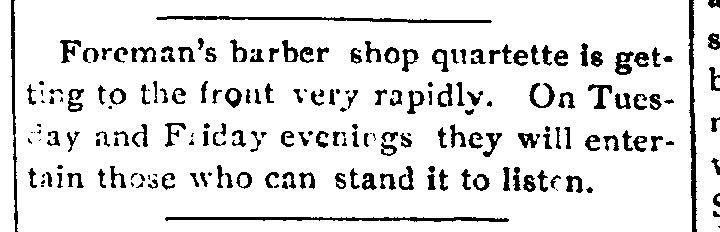
Decatur (IN) Daily Democrat, p. 1, 8 April 1892 (Newspaper Archive)
Frank C. Foreman was born in July 1865 in Indiana and was a white barber living in Decatur, Indiana, in the 1900 U.S. Census.[2] He later moved to Cincinnati, Ohio, where he died on 25 September 1929. He was buried in Oxford Cemetery in Oxford, Ohio.[3] This would seem to indicate that whites began to dabble in barbershop harmony by 1892. In Scranton, Pennsylvania in 1893, “the barber shop quartette entertained the friends at the home of Jonas Allen yesterday afternoon and sang several selections in a pleasing manner.”[4] Most references to a barbershop quartet at this time were for singing quartets, with one exception. In Atchison, Kansas, in 1893, “The Barber Shop Quartette gave a concert Saturday on a violin, organ, banjo, and guitar.”[5] A black barbershop owner, who was the leader of a black quartet in St. Louis, was solicited by one Cresswell, the organist of the First Presbyterian Church of St. Louis, to show off the new organ at the church. The idea was to have the man sing when the organist pulled a string attached to the Vox Humana stop on the organ. Unfortunately, by the time the organist tried to demonstrate for the people he invited to listen to the organ, the black man had fallen asleep inside! The organist gave several tugs on the string, the last one so violently that it knocked Cresswell off the bench. This awakened the black man, who cursed at being awakened! “You deserve to win your bet. You certainly have a wonderful instrument here. I have heard Vox Humana pipes that could sing, but this is the only one I ever knew that could curse,” retorted one of the individuals called upon to judge the performance of the organ.[6]
The first references to barbershop chords also come from the 1890s. “The Lyceum Quartette extracted all the barber shop chords from several popular songs,” announced the Buffalo (NY) Enquirer in 1893.[7]
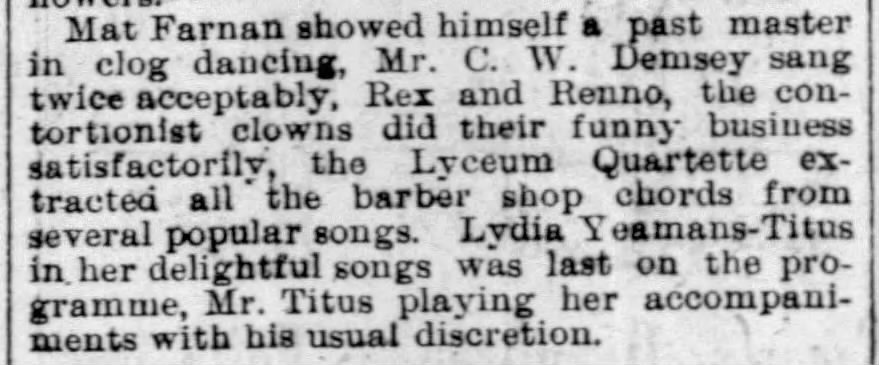
Buffalo (NY) Enquirer, 13 June 1893, p. 5 (Newspapers)
The earliest organized group which required the ability to sing barbershop chords for membership was the Harmony Club of Poughkeepsie, New York, formed in 1897: “To be eligible for this exclusive club, a man must possess a reasonably good voice, and be capable of producing ‘barber shop chords’ at will.”[8]
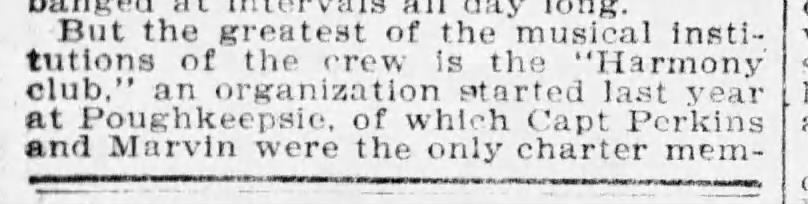
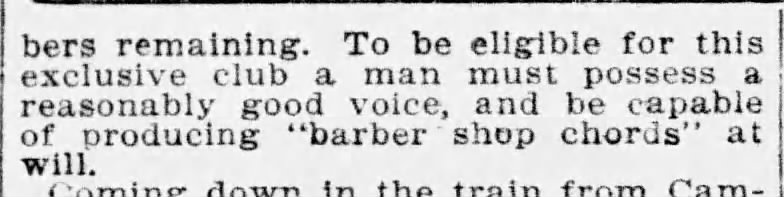
Boston (MA) Globe, 12 June 1898, p. 16 (Newspapers)
The harmony club brings out another cultural contribution to barbershop harmony: the Germans. The existence of clubs can be seen in early nineteenth century newspapers, such as the mention of the Harmony Club in Hamburg, Germany, which was closed for a period of time in 1814 (The Freeman’s Journal [Dublin, Ireland], 10 January 1814, p. 3, Newspapers, accessed 4 July 2023). German immigration to the United States in the 1830s and 1840s led to the establishment of harmony clubs amongst German-American communities. The Gesang-Verein Harmonie Club was founded in Detroit in 1849 and started with ten members who all knew German lieder (art songs). The club continued to exist until 1974 (https://historicdetroit.org/buildings/the-harmonie-club). Not all German harmony clubs were centered on music. Some were social clubs for Germans, such as the one founded in 1852 in New York City (https://www.nyhistory.org/community/harmonie-club). Another harmony club that was focused on music was the Augusta Harmonie Verein in Augusta, Missouri. Founded on 13 January 1856, the Augusta Harmonie Verein was devoted primarily “to music and good fellowship” (https://www.artbybryanhaynes.com/shop/augusta-harmonie-verein/; “Early German Settlers Found Way to Get Around Temperance Laws,” Washington (MO) Missourian, 16 June 1955, p. 17, Newspapers, accessed 4 July 2023). The group performed at the annual festivals in Augusta (Anita M. Mallinckrodt, “145 Years of German-American Fests,” St. Charles County Heritage XIX (no. 4): 125 (October 2001).) The Augusta Harmonie Verein disbanded in 1922 (“Augusta Celebrates and Launches Revitalization of Harmonie Verein,” Boone Country Connection, 31 January 2020, https://boonecountryconnection.com/news/community-interest/7241-augusta-celebrates-and-launches-revitalization-of-harmonie-verein, accessed 4 July 2023). A men’s choir (männerchor) was founded in Augusta in 1882 and they celebrated their second anniversary on 13 May 1884 with “instrumental and vocal entertainment with some theatrical pieces, and an appropriate quantity of refreshments, which last is not to be avoided” (St. Charles Cosmos, 7 May 1884, p. 4, Newspapers, accessed 4 July 2023). The men’s choir continued to perform as late as 1897 (Marthasville (MO) News, 8 April 1897, p. 4, Newspapers, accessed 4 July 2023). Although harmony clubs existed throughout the United States and in many places in Missouri (including Sedalia, Missouri, see Cole County Democrat [Jefferson City, MO], 4 January 1889, p. 1, Newspaper Archive, accessed 4 July 2023), none seemed to sing barbershop harmony or require it except for the one mentioned earlier in Poughkeepsie, New York. The quartet clubs and harmony clubs were predecessors to barbershop chapters in the sense that neither quartet clubs nor harmony clubs required singers to be trained vocalists in order to participate.
The earliest barbershop arrangement to appear in print was that of “On the Banks of the Wabash,” which accompanied a full-scale description of barbershop harmony, entitled “Barber Shop Chords,” in the Kansas City (MO) Star, in 1899.
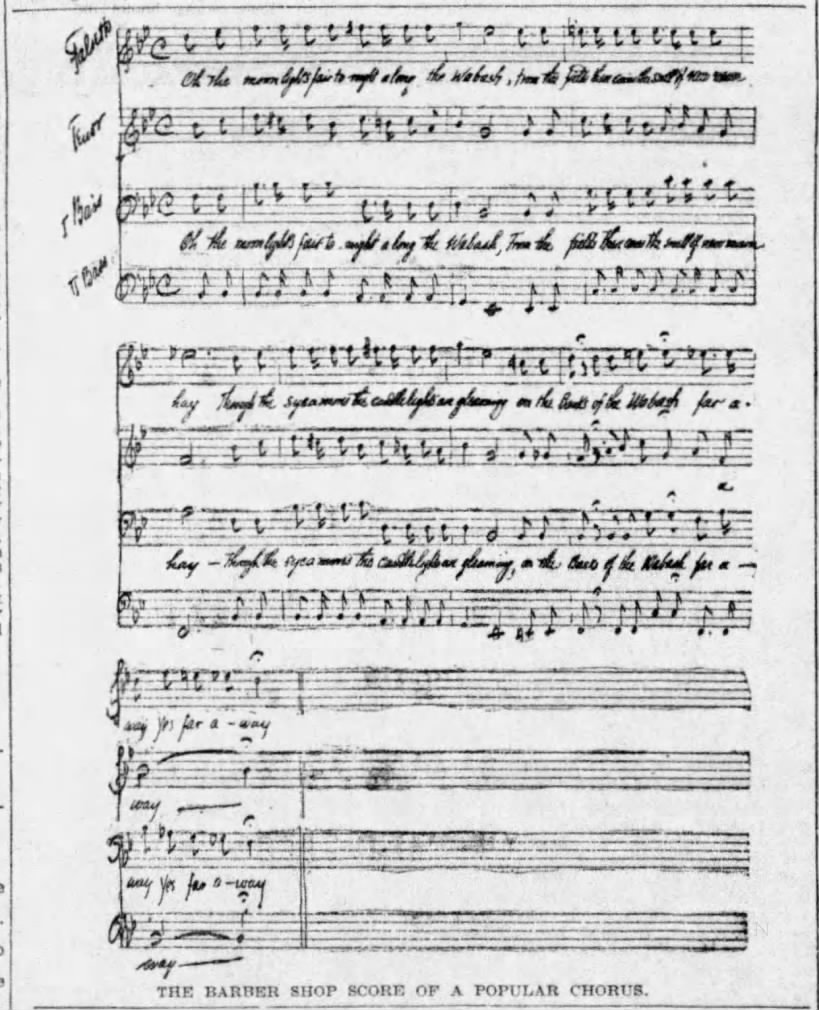
Kansas City (MO) Star, 7 May 1899, p. 7 (Newspapers)
The article points out that both whites and blacks were singing in barbershop quartets, but the author preferred the black barbershop singers to the white ones: “The Negro is the champion chord singer, however. A quartette of Negro waiters sitting on the back steps of a hotel on a moonlit night can do more to make one glad that music was invented than Theodore, Thomas, or Sousa, or any of them. They discover music as they go along. They start out on the chorus of a song and on the third note find that it has fine possibilities for making a chord …”[9] Not everyone was fond of barbershop music. Ragtime music was criticized as being simple by an unnamed man in Chicago in 1899: “The formula for writing this sort of stuff is two bars of overcoat music and four barbershop chords.” The man then went on to explain that those who played ragtime often had the music stuffed in their overcoats before they performed (Marion County [MO] Herald, 4 May 1899, p. 7, Newspapers, accessed 4 July 2023). The following year, “Tom the Tattler” wrote an obituary for the barbershop quartet in the Indianapolis (IN) Freeman: “A noticeable advancement along the musical lines of the profession is the passing of the barber shop quartette with its barber shop harmony.” The author went on to describe barbershop chords as “a musical slang” which “violates—at times ruthlessly—the exacting rules and proprieties of music.”[10]
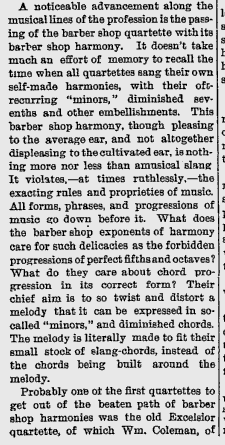
Indianapolis (IN) Freeman, 8 December 1900, p. 2 (Google News Archive)
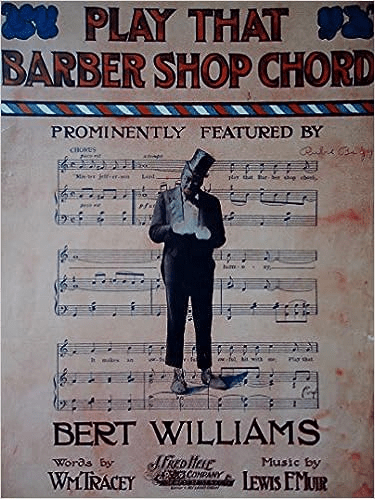
This 1900 obituary of barbershop harmony turned out to be quite premature! Prior to the above discovery, it was thought that the earliest reference to barbershop chords was the song, “Play that Barber Shop Chord” by Lewis Muir, recorded in 1910 by Bert Williams (https://www.youtube.com/watch?v=b1OOF4i2Noc, accessed 17 July 2023).
The earliest documented quartet in St. Charles, Missouri, was the male quartet of the St. Charles College, which performed at the Odd Fellows Hall in St. Charles in June 1881 (St. Charles Cosmos, 15 June 1881, p. 1, Newspapers, accessed 4 July 2023). Churches also had male quartets, such as that formed by the Jefferson Street Presbyterian Church. They performed for the Ladies’ Aid Society of the church at the home of Mrs. E. G. Ferguson on Jefferson Street in 1904.[11] Although there are no references to barbershop quartets in St. Charles at the time, barbershop quartets were found in St. Louis throughout the first few decades of the twentieth century. A barbershop quartet performed at the fall meeting of the City Club “Snoopers” in the Victoria Theater on 2 December 1914.[12]
Barbershop quartets did not entirely fizzle out, but vaudeville (which was the primary outlet for barbershop quartets) was on the wane in influence by 1938. The Society for the Preservation and Encouragement of Barber Shop Quartet Singing in America, Inc. was founded on 11 April 1938 in Tulsa, Oklahoma, by Owen Clifton Cash and Rupert Hall.[13] Two months later, the first barbershop chapter in St. Louis, St. Louis No. 1, was founded.[14] The first convention of S.P.E.B.S.Q.S.A. was held in Tulsa, Oklahoma, the first week of June in 1939.[15] The fledgling society had its first controversy at its annual convention in 1941, held at the Coronado Hotel in St. Louis. A quartet from New York was rejected due to being African American. Owen Cash’s official note on 27 June 1941 to James V. Mulholland, Director of Recreation of the Department of Parks for the City of New York, stated that the board of directors of S.P.E.B.S.Q.S.A. decided in 1940 “that to keep down any embarrassment we ought not to permit colored people to participate.” New York City Park Commissioner Robert Moses replied to Cash, “that if American ballads of Negro origin are to be ruled out of barber shop singing, most of the best songs we have will be blacklisted. There was a man named Stephen Foster who never hesitated to acknowledge his debt to the Negroes for the best of his songs.” Moses and New York Governor Alfred E. Smith left the S.P.E.B.S.Q.S.A. over the banning of this quartet to represent New York at the barbershop music convention in St. Louis.[16] Cash thought blacks should form their own auxiliary organization of barbershop singers.[17] The ban on black membership in S.P.E.B.S.Q.S.A. was lifted in 1963.[18]
While barbershop harmony was striking chords in St. Louis, the town of St. Charles did not have its own barbershop chapter. However, barbershop music was not without its cameo appearances. The top KMOX Barber Shop Male Quartet performed at St. Charles High School in St. Charles on 10 February 1944 (St. Charles Cosmos-Monitor, 19 January 1944, p. 3, Newspapers, accessed 4 July 2023). The St. Charles Cosmos-Monitor invited its readers to join the S.P.E.B.S.Q.S.A. if they were “males, free, white, twenty-one” and “can sing–and those who can’t” (“St. Charles Citizens Invited to Join Barber Shop Quartet,” St. Charles Cosmos-Monitor, 16 August 1944, p. 5, Newspapers, accessed 4 July 2023). All Saints’ Dramatic Club in St. Peters performed at Francis Howell High School in Weldon Spring, Missouri, in 1944. The club featured its own barbershop quartet! (St. Charles Cosmos-Monitor, 8 November 1944, p. 5, Newspapers, accessed 4 July 2023). A barbershop quartet affiliated with S.P.E.B.S.Q.S.A. performed at the Kiwanis Club’s meeting at the V.F.W. Hall at Fourth and Jefferson streets in 1950 (“Ray Barklage Heads Kiwanis,” St. Charles Banner-News, 19 January 1950, p. 1, Newspapers, accessed 4 July 2023). Attempts to start a barbershop chapter in St. Charles seem to have begun after World War II. The St. Louis and Clayton chapters of S.P.E.B.S.Q.S.A. performed at the V.F.W. Hall in St. Charles at a meeting in view of creating a St. Charles chapter in 1950. City Councilman Harold H. Linhoff was elected temporary chairman. [19] Dr. Lustig of Lindenwood College was selected as musical director for the chapter two weeks later.[20] The Friedens 4-H Club and Extension Club entertained about eighty people with a performance that included a barbershop quartet in 1951 (St. Charles Cosmos-Monitor, 4 April 1951, p. 4, Newspapers, accessed 4 July 2023). A second attempt to found a chapter was spearheaded by Ted Huesemann of St. Charles in 1958, but this attempt also failed.[21] Apparently, there was not enough interest and St. Charles still did not have a chapter. A barbershop quartet performed at a picnic in O’Fallon, Missouri, put on as a benefit for playground improvement at the O’Fallon ballpark, which was located just east of the Forest Park subdivision, in 1960 (O’Fallon [MO] Community News, 28 July 1960, p. 1, Newspapers, accessed 4 July 2023). Although barbershop quartets were now appearing in St. Charles County, it was not until 1963 when a lasting barbershop chapter was formed.
The St. Charles Chapter of the S.P.E.B.S.Q.S.A., Inc. was founded in 1963, when a call went forth with the colorful introductory statement: “Calling all bathtub baritones.” With that, barbershop harmony officially arrived in St. Charles to stay.
[1] Decatur (IN) Daily Democrat, 8 April 1892, Newspaper Archive, accessed 27 February 2018
[2] Ancestry.com. 1900 United States Federal Census [database on-line]. Provo, UT, USA: Ancestry.com Operations Inc, 2004. Accessed 1 July 2020
[3] https://search.ancestry.com/cgi-bin/sse.dll?viewrecord=1&r=an&db=FindAGraveUS&indiv=try&h=148058849, accessed 1 July 2020
[4] Scranton (PA) Republican, 16 May 1893, Newspapers.com, accessed 27 February 2018
[5] Atchison (KS) Weekly Graphic, 29 April 1893, Newspapers.com, accessed 17 December 2018
[6] St. Louis Post-Dispatch, 4 November 1894, Newspapers.com, accessed 17 December 2018
[7] Buffalo (NY) Enquirer, 13 June 1893, Newspapers.com, accessed 1 July 2020
[8] Boston Globe, 12 June 1898, Newspapers.com, accessed 1 July 2020
[9] Kansas City (MO) Star, 7 May 1899, Newspapers.com, accessed 1 July 2020
[10] Indianapolis (IN) Freeman, 8 December 1900, Google News, accessed 11 July 2020
[11] St. Charles (MO) Daily Banner-News, 13 April 1904, on microfilm at Kathryn Linnemann Branch, St. Charles City-County Library District
[12] St. Louis Star-Times, 21 November 1914, Newspapers.com, accessed 31 July 2019
[13] https://www.barbershop.org/about/history-of-barbershop/the-history-of-the-society, accessed 2 July 2020
[14] St. Louis Post-Dispatch, 16 June 1938, Newspapers.com, accessed 21 November 2019
[15] Hutchinson (KS) News, 3 June 1939, Newspaper Archive, accessed 27 February 2018
[16] “Negro Singers Out, Smith, Moses Quit,” New York Times, 3 July 1941, ProQuest Newspapers, accessed shortly after the article based on this newspaper account appeared in The Harmonizer.
[17] “Al Smith Takes Another Walk Because Singers Bar Negroes,” St. Louis Globe-Democrat, 3 July 1941
[18] Dr. Jim Henry, “Roots of Barbershop Harmony,” The Harmonizer LXI, no. 4 (July 2001): 15
[19] “Councilman Heads Male Sing Group,” St. Charles Banner-News, 21 March 1950, KL-SCCCLD microfilm
[20] “SPEBSQSA Meeting,” St. Charles Banner-News, 3 April 1950, KL-SCCCLD microfilm
[21] “SPEBSQSA?” St. Charles Daily Banner-News, 26 May 1958, KL-SCCCLD microfilm
 Historical Projects of Justin Watkins